Have you ever received a message mentioning “SMS” and wondered whether it has a special slang meaning? You may see these three letters in text conversations, social media posts, phone settings, or discussions about messaging.
Although SMS can look like internet slang, it has a widely recognized meaning that is connected to everyday mobile communication.
The SMS meaning slang search usually relates to understanding what SMS stands for and how people use it when talking about messages.
SMS means “Short Message Service,” the technology traditionally used to send text messages between mobile phones. In casual conversations, people often use SMS to refer to an ordinary text message or the service used to send one.
Unlike many texting abbreviations, SMS is not primarily a slang expression. It is a technical abbreviation that has become part of everyday language.
Understanding the difference helps you interpret it correctly in private chats, WhatsApp discussions, Instagram conversations, and other online settings. The exact meaning can still depend on how the term appears in a sentence.
Quick Answer
SMS stands for “Short Message Service,” the standard technology used to send text messages between mobile phones. The SMS meaning slang searches usually concern how people refer to ordinary text messaging in casual conversations. Although SMS is common in chats and social media, it is a technical abbreviation rather than slang in the traditional sense.
1. Meaning and Definition of SMS
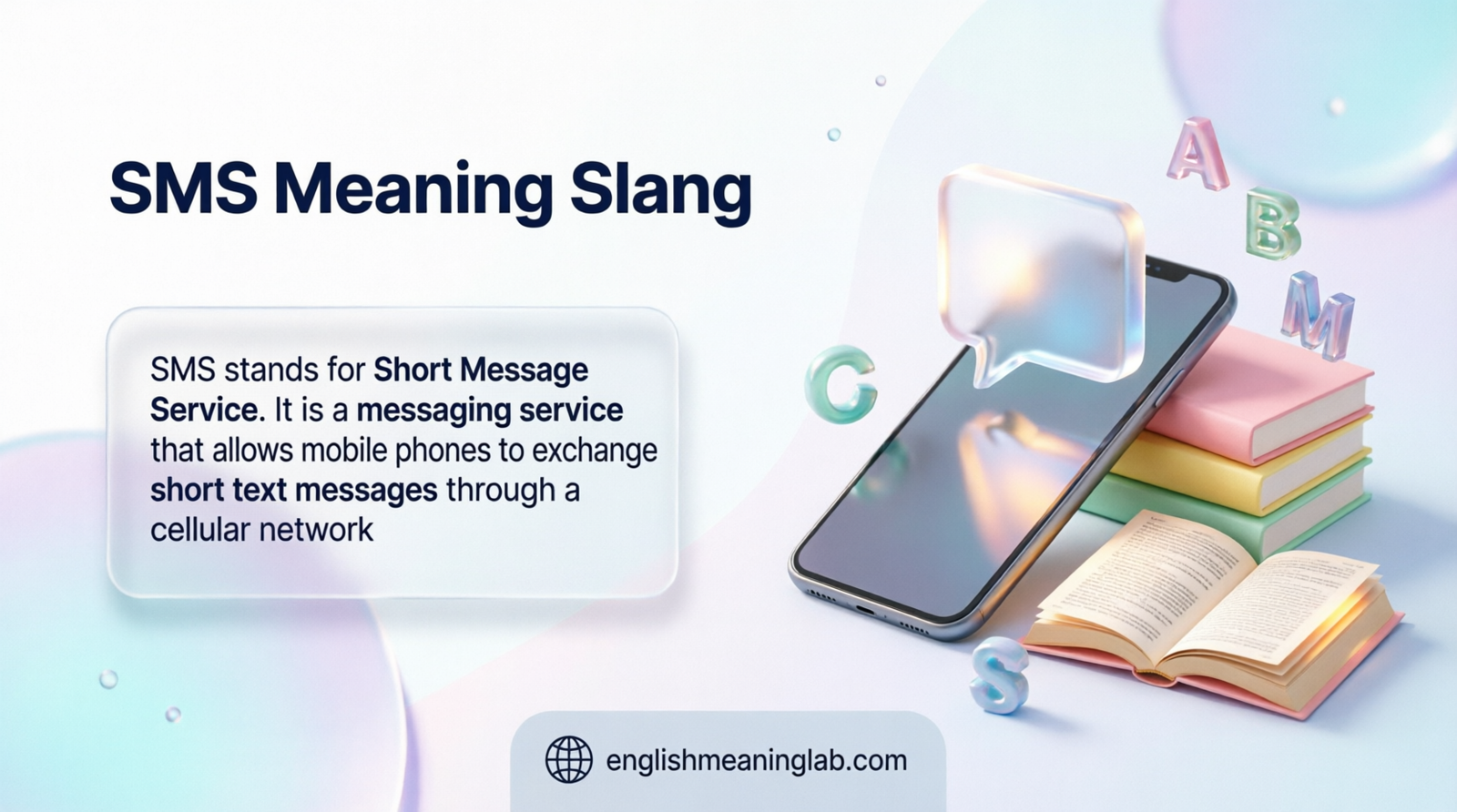
SMS stands for Short Message Service. It is a messaging service that allows mobile phones to exchange short text messages through a cellular network.
In everyday conversation, people often use SMS to mean a standard mobile text message. For example, someone might say, “I’ll send you an SMS when I arrive.” This means they will send a text message to let the other person know they have arrived.
Is SMS a slang word?
SMS is not originally a slang word. It is a technical abbreviation that has become familiar in everyday communication.
Slang typically includes informal expressions whose meanings develop through social use. Examples include “LOL,” meaning “laughing out loud,” and “BRB,” meaning “be right back.” SMS, by contrast, names a messaging service.
However, people sometimes use the term casually:
- “Send me an SMS.”
- “I got your SMS.”
- “Check your phone for my SMS.”
- “I’ll reply by SMS.”
These sentences show how a technical term can become part of ordinary conversation.
What does SMS mean in a text message?
When someone mentions SMS in a conversation, they are usually talking about sending or receiving a conventional text message.
For example:
Person A: “Did you receive the confirmation?”
Person B: “Yes, I got an SMS.”
Here, SMS refers to the text message containing the confirmation.
The abbreviation does not usually communicate an emotion, joke, or hidden message. Its purpose is to identify the type of communication being discussed.
SMS versus a text message
In everyday usage, SMS and text message are often treated as interchangeable. Technically, however, SMS refers to the specific messaging service, while “text message” can be used more broadly.
For instance, a person might call a message sent through a messaging app a text even when it is not an SMS.
Understanding this distinction is useful when discussing phone plans, messaging charges, delivery notifications, or the difference between traditional texting and internet-based messaging.
2. Background: Where Did SMS Come From?
SMS developed as a way to send short written messages through mobile communication networks. Its purpose was practical: it allowed people to exchange text without making a voice call.
The abbreviation comes directly from the name “Short Message Service.” Unlike many internet expressions, it was not originally created as a nickname or playful phrase.
The development of mobile texting
As mobile phones became more widely used, text messaging became an important way to communicate. People could send brief updates, confirmations, reminders, and personal messages without needing to speak directly.
This made SMS useful in situations where a phone call was inconvenient or unnecessary.
For example, a person could text, “I’m outside,” rather than calling to announce their arrival.
Why SMS became part of everyday language
Over time, people began using the term outside technical discussions. Phone companies referred to SMS in service descriptions, mobile plans, and billing information. Users encountered it when learning how to send messages or troubleshoot their phones.
Eventually, SMS became a familiar word in ordinary conversation.
Someone might say, “I’ll SMS you the address,” using SMS as a verb. This informal usage means that the person intends to send the address in a text message.
SMS and the rise of messaging apps
Modern communication includes traditional SMS as well as internet-based messaging services. Apps such as WhatsApp and Instagram allow people to exchange messages using an internet connection.
Because all these services involve written communication, people sometimes use “text” as a general term for messages sent through different platforms.
However, SMS and app-based messaging are not identical. SMS uses cellular messaging infrastructure, while services such as WhatsApp generally transmit messages over the internet.
Is SMS slang today?
SMS is still primarily a technical abbreviation, although people commonly use it informally.
Its familiarity does not turn it into slang in the same way that expressions such as “LOL” or “IDK” are commonly classified as texting abbreviations.
The main point is that SMS originated as the name of a messaging service and became a familiar term as mobile texting entered everyday life.
3. Usage in Different Contexts
SMS can appear in casual chats, social media discussions, workplace communication, and technical information. Its meaning usually remains connected to text messaging, but the purpose of the conversation may differ.
SMS in chat
In private conversations, SMS usually refers to a standard text message sent to a mobile number.
Example:
“Can you send me the details by SMS?”
The sender is asking for the information to be sent as a text message.
Another example is:
“I didn’t get your SMS.”
This means the person has not received the message.
SMS on social media
On social media, people may mention SMS when discussing phone verification, account security, notifications, or communication outside a platform.
For example:
“The app sent me an SMS with a verification code.”
Here, SMS refers to a text message containing a code.
A social media post might also say, “DM me instead of sending an SMS.” In this sentence, SMS is being contrasted with a direct message.
SMS in professional communication
SMS is common in business and professional settings because organizations often send text notifications and reminders.
Examples include:
- Appointment reminders sent by text.
- Delivery updates.
- Login verification codes.
- Banking transaction alerts.
- Service notifications.
A business might write, “You will receive an SMS confirmation after booking.” This means a confirmation message will be sent to the customer’s mobile phone.
In professional writing, SMS is generally acceptable because it identifies a recognized communication service.
SMS in casual conversations
People may use SMS as a noun or an informal verb.
Examples:
- “I’ll send you an SMS later.”
- “SMS me when you’re free.”
- “Did you get my SMS?”
In these examples, the word is used naturally to describe sending or receiving a text.
Can SMS have a slang meaning?
The abbreviation does not have one widely established alternative slang meaning that applies to ordinary conversations. If someone uses SMS in a private joke or a specific online community, the intended meaning might be different.
In most situations, however, the simplest interpretation is correct: the person is talking about a text message or the service used to send it.
4. SMS Meaning in Chat, WhatsApp, Instagram, and TikTok
SMS may appear across messaging apps and social media, but it does not mean that every message sent through those platforms is technically an SMS.
SMS meaning in chat
In ordinary chat, SMS usually means a text message sent through a mobile messaging service.
Example:
Message: “I’ll send the location by SMS.”
Meaning: “I’ll send the location in a text message.”
People may use the term when discussing whether a message was delivered or when choosing how to share information.
SMS meaning on WhatsApp
WhatsApp primarily uses an internet connection to exchange messages rather than the traditional SMS service.
However, SMS may come up when someone discusses receiving a verification code while setting up an account or comparing WhatsApp messages with regular phone texts.
Example:
“I received an SMS code to verify my number.”
In this sentence, SMS refers to the text message containing the verification code, not an ordinary WhatsApp chat message.
SMS meaning on Instagram
Instagram users may mention SMS when discussing login verification, security codes, or messages sent to their mobile numbers.
For example:
“Instagram asked me to enter the code sent by SMS.”
This means a text message was sent to the user’s phone for verification.
An Instagram direct message is different from an SMS, even though both allow people to exchange written messages.
SMS meaning on TikTok
On TikTok, SMS may appear in discussions about account verification, login problems, security notifications, or phone settings.
For example:
“Check your SMS for the confirmation code.”
The person is being asked to look for a text message on their mobile phone.
TikTok’s in-app messages and traditional SMS are separate communication methods.
SMS versus DMs
A direct message, often called a DM, is a private message sent through a platform such as Instagram or TikTok. SMS is a service for sending text messages through mobile networks.
The difference matters because people may use the word “text” casually for both types of communication.
If someone says, “Text me instead of DMing me,” they may mean they prefer receiving a regular phone message rather than an in-app message.
5. SMS Meaning in Physics, Medical, and Aircraft Terminology
SMS is used beyond everyday texting. In specialized fields, the same abbreviation can represent different concepts. Therefore, context is essential when interpreting it.
SMS in physics
SMS does not have one universal meaning across all areas of physics. In ordinary scientific discussion, the abbreviation is not a general replacement for a standard physical quantity or unit.
If SMS appears in a physics paper, laboratory document, or technical diagram, its meaning should be determined from the surrounding text or the document’s glossary.
It would be inaccurate to assign it a specific physics definition without further context.
SMS in medical terminology
In medical settings, SMS commonly refers to Short Message Service when discussing appointment reminders, patient notifications, or text-based communication.
However, medical documents can use abbreviations that vary by specialty and institution. SMS should not automatically be assigned a separate clinical meaning without checking the relevant context.
For example, a hospital might send an SMS to remind a patient about an appointment. In that situation, it refers to a standard text message rather than a diagnosis or medical condition.
SMS in aircraft and aviation terminology
In aviation, SMS is a recognized abbreviation for Safety Management System.
A Safety Management System is an organized approach to managing safety risks and improving safety performance within an aviation organization.
For example, an aviation document might discuss an airline’s SMS when explaining its safety policies, risk assessment processes, or safety reporting procedures.
This meaning is different from Short Message Service, even though the abbreviation is identical.
How can you tell which meaning applies?
Look at the subject of the conversation.
- A mobile phone message usually points to Short Message Service.
- An aviation safety document may use SMS to mean Safety Management System.
- A specialized scientific or medical document may define the abbreviation for its own purpose.
Never assume that an abbreviation has the same meaning in every industry. The surrounding words and the subject of the document usually provide the most reliable clues.
6. Common Misconceptions About SMS
SMS is familiar to many people, but several misunderstandings can arise when it appears in online conversations.
Misconception 1: SMS is slang
SMS is primarily a technical abbreviation, not a slang expression.
People use it informally, but its standard meaning comes from the name Short Message Service. This differs from expressions such as “LOL,” “OMG,” and “TBH,” which are widely used as informal internet abbreviations.
Misconception 2: Every text message is an SMS
Not necessarily. SMS is a particular messaging service, while people often use “text message” more broadly.
A message sent through WhatsApp, Instagram, or another internet-based platform is not automatically an SMS.
Misconception 3: SMS and WhatsApp are the same
They both support written communication, but they operate differently.
Traditional SMS uses mobile messaging infrastructure. WhatsApp generally uses internet connectivity to send messages through its service.
This difference can affect how messages are delivered and whether an internet connection or a mobile messaging plan is needed.
Misconception 4: SMS always refers to mobile texting
In everyday communication, this is usually the intended meaning. However, specialized fields can use the same abbreviation differently.
Aviation is an important example because SMS can stand for Safety Management System.
Misconception 5: SMS has a hidden romantic meaning
Unlike terms such as “bae” or “ILY,” SMS does not ordinarily express affection or romantic interest.
If someone says, “I’ll send you an SMS,” they are talking about sending a text message, not expressing a feeling.
Misconception 6: SMS and MMS mean the same thing
SMS is associated with text messages, while MMS stands for Multimedia Messaging Service and supports multimedia content such as pictures and videos.
Although the services are related, they are not identical.
Recognizing these distinctions helps you interpret SMS accurately in conversations, phone settings, professional documents, and technical discussions.
7. Similar Terms and Alternatives
Several abbreviations are related to SMS or commonly appear in conversations about mobile communication.
| Term | Full meaning | Main use |
|---|---|---|
| SMS | Short Message Service | Traditional text messaging |
| MMS | Multimedia Messaging Service | Sending multimedia messages |
| DM | Direct message | Private messaging on a platform |
| PM | Private message | A private online message |
| IM | Instant messaging | Real-time or near-real-time messaging |
| RCS | Rich Communication Services | Enhanced messaging supported by compatible devices and networks |
| OTP | One-time password | A temporary code used for verification |
| TXT | Informal shortening of “text” | Casual reference to texting |
| LOL | Laughing out loud | Expressing amusement |
| BRB | Be right back | Saying you will return shortly |
SMS vs. MMS
SMS is associated with conventional text messaging, while MMS supports multimedia content such as images and videos.
For example, a short text-only message may be sent as an SMS, whereas a message containing a photograph may use MMS or another supported messaging system.
The actual method depends on the phone, carrier, and messaging configuration.
SMS vs. DM
SMS generally refers to a message sent through a mobile messaging service. A DM is a private message sent through a social platform or application.
For example, an Instagram DM stays within Instagram’s messaging system, while an SMS is sent to a mobile number through the SMS service.
SMS vs. IM
IM stands for instant messaging, a broad category of communication through messaging applications.
SMS and instant messaging can both involve written messages, but they do not refer to the same technology.
SMS vs. RCS
RCS stands for Rich Communication Services. It is designed to support enhanced messaging features, which can include typing indicators, read receipts, and higher-quality media sharing when supported.
SMS is a more basic messaging service. The availability of RCS features depends on device, software, carrier, and service support.
SMS vs. slang abbreviations
SMS is different from terms such as LOL, IDK, and IMO. Those abbreviations represent expressions people use in conversations, while SMS names a messaging service.
This distinction is especially helpful when someone searches for the SMS meaning in slang and expects an emotional or conversational definition.
8. How to Respond When Someone Mentions SMS
Because SMS usually refers to text messaging, your response should depend on what the other person is asking or explaining.
If someone asks you to send an SMS
You can confirm that you will send the message.
Examples:
- “Sure, I’ll text you.”
- “Okay, I’ll send it shortly.”
- “I’ll message you when I’m free.”
- “No problem. What’s your number?”
These responses are natural and appropriate for casual or professional communication.
If someone asks whether you received an SMS
You can confirm whether the message arrived.
Examples:
- “Yes, I received it.”
- “Not yet. Could you send it again?”
- “I got the message, thanks.”
- “I haven’t received anything so far.”
If the SMS contains a verification code, follow the instructions from the service that requested it. Do not share sensitive verification codes with someone who asks for them unexpectedly.
If someone says they sent you an SMS
A simple acknowledgment is usually enough.
Examples:
- “Thanks, I’ll check my messages.”
- “Got it!”
- “I’ll have a look now.”
- “Thanks for letting me know.”
If you are unsure what SMS means
You can ask for clarification without making the conversation awkward.
For example:
“Do you mean a regular text message to my phone?”
This is particularly useful if the discussion involves several messaging apps or technical terminology.
If SMS appears in an aviation document
If someone mentions SMS in an aviation safety discussion, it may refer to a Safety Management System rather than text messaging.
You could ask, “Are you referring to the aviation Safety Management System?”
The best response always depends on the context. In everyday chats, SMS usually refers to text messaging; in specialized settings, it may have a different established meaning.
9. Differences Between SMS and Similar Expressions
Understanding how SMS differs from other messaging terms can prevent confusion in everyday conversations.
SMS vs. “text”
SMS is the formal abbreviation for Short Message Service. “Text” is a more general everyday word that can refer to a written message.
For example, “I’ll send you a text” sounds natural and informal, while “I’ll send you an SMS” can sound slightly more technical.
Both commonly refer to sending a message to someone’s mobile phone.
SMS vs. “message”
A message can be any communication, including an email, social media DM, voice message, or SMS.
SMS is more specific because it identifies a particular type of text messaging service.
For example, “I received your message” does not explain which platform was used, while “I received your SMS” points to a conventional text message.
SMS vs. “texting”
Texting describes the activity of exchanging text messages. SMS identifies the service traditionally used for sending those messages.
For example:
- “I’m texting my friend” describes an activity.
- “I sent an SMS” describes a message sent through the SMS service.
In casual conversation, these distinctions may not always matter, but they are useful when discussing technology.
SMS vs. “DM me”
“DM me” means “send me a direct message” through a platform that supports private messaging.
“SMS me” usually means “send me a traditional text message.”
The two phrases may communicate the same general intention—contact me—but they suggest different communication methods.
SMS vs. “ping me”
“Ping me” is an informal expression meaning to contact or notify someone. Depending on the situation, it may refer to a message, a call, or another brief notification.
SMS is more specific because it refers to the text messaging service.
For example, “Ping me when you arrive” does not specify the communication method, while “Send me an SMS when you arrive” does.
10. Relevance in Online Conversations and Dating Apps
SMS remains relevant in modern communication even though many people use internet-based messaging apps. It can appear in personal conversations, online account verification, business notifications, and dating-app interactions.
SMS in dating apps
A person using a dating app might mention SMS when discussing moving a conversation to regular phone texting.
For example:
“Would you prefer to continue chatting here or by SMS?”
This means the person is asking whether you would like to communicate through ordinary mobile text messages instead of the dating app.
It does not have a special romantic meaning by itself.
SMS when exchanging phone numbers
After meeting someone online, people may exchange phone numbers and continue their conversations through SMS.
Example:
“I’ll send you an SMS when I get home.”
The person is promising to send a text message later. Any romantic significance comes from the wider relationship, not from the abbreviation itself.
SMS for verification and notifications
Online services may use SMS to send confirmation codes, login alerts, or account-related notifications.
For example:
“Enter the code sent to your phone by SMS.”
This is an instruction about account verification rather than a slang expression.
SMS and personal privacy
When moving from an app to SMS, consider your comfort level before sharing your phone number. A phone number may reveal personal information or make it easier for someone to contact you outside the original platform.
You can continue using an app’s messaging system if you prefer not to share your number.
Does SMS mean someone likes you?
No. SMS itself does not indicate attraction, love, or romantic interest. It refers to a messaging service.
If someone asks to text you, the request may simply reflect convenience or personal preference. Their intentions are better understood through the actual conversation and their behavior over time.
In short, SMS can support personal and romantic communication, but the abbreviation itself remains a neutral term for messaging technology.
FAQs
1. What does SMS mean in a text message?
SMS stands for Short Message Service, the technology traditionally used to send text messages between mobile phones. When someone mentions receiving an SMS, they usually mean they received a regular text message. It is a technical abbreviation rather than a slang expression with a hidden emotional meaning.
2. Is SMS considered slang?
No, SMS is primarily a technical abbreviation, not traditional slang. People use it informally in everyday conversation, but it stands for Short Message Service. Unlike expressions such as LOL or IDK, it identifies a messaging service rather than representing a phrase people commonly use to communicate an emotion or reaction.
3. What does SMS mean on WhatsApp or Instagram?
On WhatsApp or Instagram, SMS usually refers to a regular mobile text message, often one used for verification or account security. WhatsApp chats and Instagram direct messages are separate from traditional SMS. The exact meaning depends on whether the conversation concerns phone messaging, app notifications, or verification codes.
4. What is the difference between SMS and MMS?
SMS stands for Short Message Service and is associated with traditional text messaging. MMS stands for Multimedia Messaging Service and supports multimedia content, such as images and videos. The two services are related, but their capabilities differ. Modern phones may use other messaging systems for media depending on device and network support.
5. What does SMS mean in aviation?
In aviation, SMS can stand for Safety Management System. It refers to an organized approach to managing safety risks and improving safety performance within an aviation organization. This meaning differs from Short Message Service, so the surrounding subject matter is important when interpreting the abbreviation in technical documents.
6. Can SMS have more than one meaning?
Yes, SMS can have different meanings in different contexts. It most commonly means Short Message Service in mobile communication, while in aviation it can refer to a Safety Management System. Other specialized uses may exist within particular organizations or documents, so the relevant industry and surrounding text should guide interpretation.
7. How should I reply when someone says they sent an SMS?
You can respond naturally by confirming whether you received the message. For example, say “Thanks, I’ll check it,” “Yes, I got it,” or “I haven’t received it yet.” If you are unsure whether the person means a regular phone text or an in-app message, ask them to clarify.
8. Does SMS mean the same thing as texting?
SMS and texting are closely related, but they are not exactly identical. SMS names a specific messaging service, while texting describes the activity of sending written messages and may be used more broadly. In everyday conversation, people often use both terms to refer to ordinary mobile text messages.
Conclusion
SMS stands for Short Message Service and is the technology traditionally used to send text messages between mobile phones.
Although people sometimes search for its slang meaning, SMS is not primarily a slang expression. In everyday conversation, it usually refers to a regular text message or the service used to send one.
The abbreviation can appear in private chats, phone settings, WhatsApp discussions, Instagram messages, TikTok content, and professional notifications.
However, the letters can have different meanings in specialized fields. In aviation, for example, SMS commonly stands for Safety Management System.
Understanding the context is therefore essential. If someone mentions SMS in a personal conversation, they are probably talking about texting. If it appears in an aviation safety document, the technical meaning is more likely.
Recognizing the difference between SMS, MMS, DMs, and internet messaging services can help you understand digital communication more accurately and respond appropriately.