Have you ever received a message containing the 🙈 emoji and wondered what the sender was trying to say? This cute monkey emoji is commonly used in text messages, social media comments, and online conversations to express emotions that words sometimes cannot describe.
Although it may look like a simple cartoon monkey covering its eyes, it can communicate several feelings depending on the situation.
When people ask what does 🙈 mean in texting, they are usually trying to understand whether the sender feels shy, embarrassed, playful, or flirtatious.
The emoji is often associated with the idea of “I can’t look,” especially when someone feels awkward, bashful, or embarrassed about something. It can also make a conversation feel sweet, humorous, or less serious.
Understanding the 🙈 emoji is helpful because its meaning can change depending on who sends it, what was said before it, and the relationship between the people communicating.
Quick Answer
The 🙈 emoji, known as the See-No-Evil Monkey, usually represents shyness, embarrassment, bashfulness, or playful awkwardness in texting. People use it when they feel too shy to look, react to something embarrassing, or respond to a cute or flirtatious message. Its exact meaning depends on the conversation and the sender’s intention.
1. Meaning and Definition of 🙈
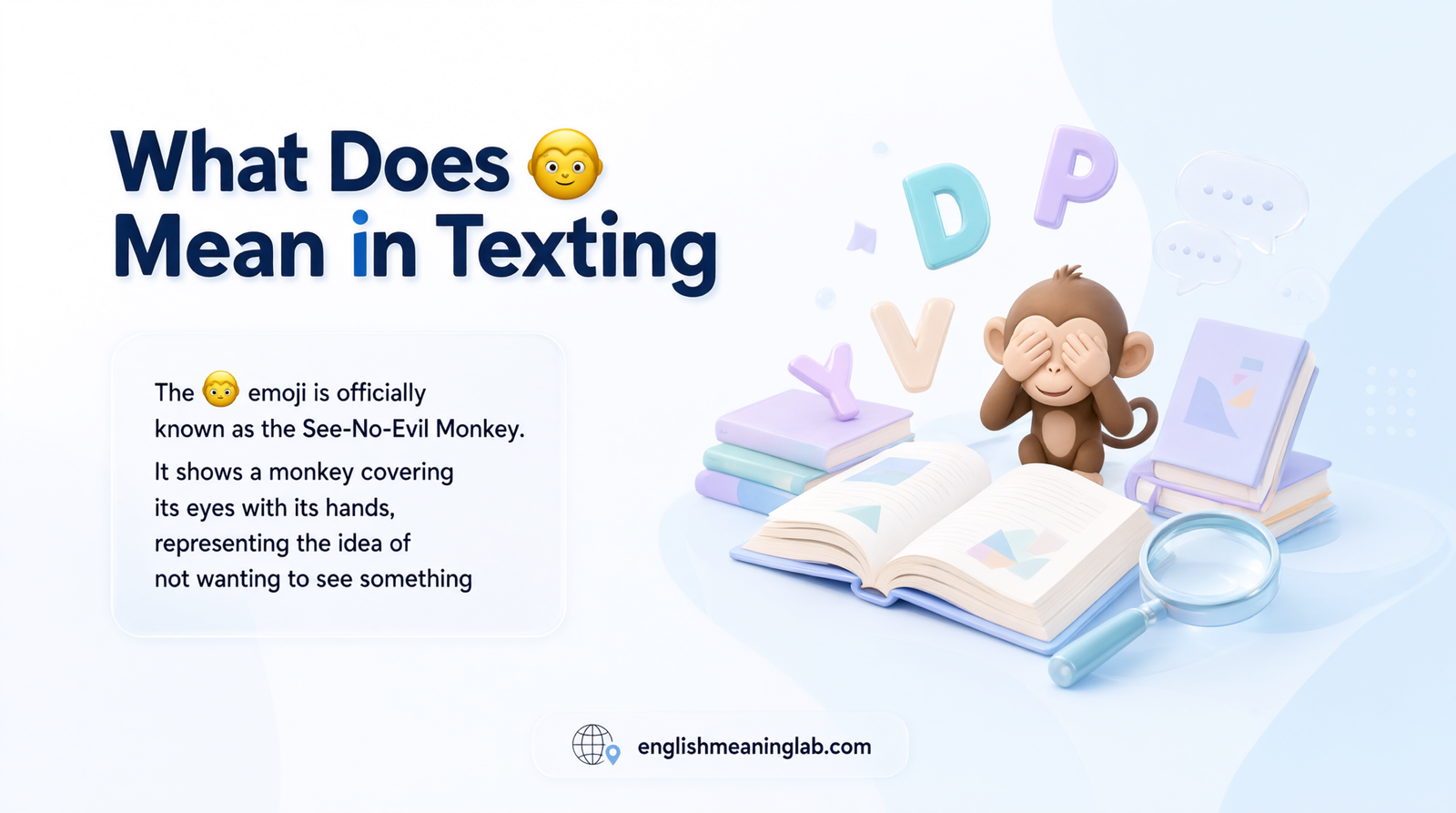
The 🙈 emoji is officially known as the See-No-Evil Monkey. It shows a monkey covering its eyes with its hands, representing the idea of not wanting to see something.
In digital conversations, however, people often use it to express emotions rather than its literal meaning.
The most common interpretations include:
- Shyness: Feeling bashful when someone gives a compliment.
- Embarrassment: Reacting to an awkward or uncomfortable situation.
- Playfulness: Making a conversation more fun or humorous.
- Flirting: Showing romantic interest in a cute or indirect way.
- Surprise: Reacting to something unexpected or difficult to look at.
- Awkwardness: Communicating that a situation feels uncomfortable.
Why do people use 🙈 instead of words?
Sometimes, people find it easier to express emotions through emojis than through complete sentences.
For example, imagine someone messages you:
“You looked really beautiful today!”
You might respond:
“Stoppp 🙈”
This response suggests that you feel shy or embarrassed by the compliment, possibly because you enjoyed hearing it.
Similarly, if someone shares an embarrassing story, you might reply with 🙈 to show that you feel awkward or amused.
Does 🙈 always mean embarrassment?
No. Although embarrassment is a common interpretation, the emoji can communicate different emotions.
For example:
- “I accidentally sent the wrong message 🙈” expresses embarrassment.
- “I have a little surprise for you 🙈” creates playful excitement.
- “You’re making me blush 🙈” expresses shyness or flirtation.
- “I can’t believe you did that 🙈” communicates surprise or playful disbelief.
The surrounding message helps determine the intended meaning.
What emotion does the emoji communicate?
The 🙈 emoji generally communicates a soft, playful reaction rather than a serious emotional statement. It can make a message seem less direct and more expressive.
It is particularly useful when someone wants to show embarrassment without appearing upset or uncomfortable.
However, the emoji does not always indicate romantic feelings. Friends, family members, and romantic partners can all use it naturally.
2. Background: Where Did the 🙈 Emoji Come From?
The 🙈 emoji comes from the familiar image of the See-No-Evil Monkey, one of three symbolic monkeys traditionally associated with the principle of avoiding evil.
The three monkeys are commonly represented through three different actions:
- 🙈 See no evil: Covering the eyes.
- 🙉 Hear no evil: Covering the ears.
- 🙊 Speak no evil: Covering the mouth.
Together, these images communicate the idea of avoiding harmful sights, sounds, or words.
The traditional meaning behind the monkey
The three monkeys are associated with a traditional Japanese expression commonly translated as “see no evil, hear no evil, speak no evil.”
The imagery represents three ways of avoiding wrongdoing: not looking at what is wrong, not listening to harmful things, and not speaking harmful words.
Over time, the three-monkey imagery became recognizable in art, illustrations, decorations, and popular culture.
How 🙈 became an internet expression
When emojis became a common part of digital communication, the See-No-Evil Monkey gained another practical use.
Instead of representing only the traditional idea of avoiding something bad, people began using it to express everyday emotions.
For example, someone might use 🙈 after receiving an unexpected compliment or admitting to a silly mistake.
This makes the emoji useful in situations where a person feels embarrassed but wants to keep the conversation lighthearted.
Why is 🙈 still popular?
The emoji is popular because its visual expression is easy to understand. Covering the eyes naturally communicates that someone does not want to look at something.
In texting, this physical action can represent emotional reactions such as shyness, awkwardness, and playful embarrassment.
It also works well alongside short messages, compliments, jokes, and romantic conversations.
The exact reason a person uses it may differ, but its familiar appearance makes it a convenient way to communicate feelings without writing a long explanation.
3. Usage in Different Contexts
The 🙈 emoji can communicate different emotions depending on the situation. Understanding its context is important because the same emoji may express embarrassment in one conversation and flirtation in another.
🙈 in chat
In ordinary chats, people commonly use 🙈 when something makes them feel shy, embarrassed, or awkward.
Example:
Person A: “You made a funny mistake yesterday!”
Person B: “Don’t remind me 🙈”
Here, the emoji communicates playful embarrassment.
Another example:
Person A: “I really enjoyed talking to you.”
Person B: “Aww, thank you 🙈”
In this situation, the emoji adds a shy and affectionate tone.
🙈 on social media
On social media, 🙈 often appears in comments, captions, and reactions.
Someone might comment:
“You look amazing 🙈”
This could express admiration or playful shyness.
People also use it when posting embarrassing memories, funny mistakes, or personal experiences they find difficult to share.
🙈 in professional conversations
The emoji is generally more suitable for informal communication than formal professional settings.
However, coworkers may use it in friendly workplace chats to acknowledge a small mistake or an awkward situation.
For example:
“Forgot to attach the document again 🙈”
The emoji makes the message feel lighthearted, although it should not replace a clear apology or professional explanation when one is needed.
🙈 in casual conversations
Among friends, the emoji is often used humorously.
Examples:
- “I ate the entire cake 🙈”
- “I forgot your birthday! 🙈”
- “I have something embarrassing to tell you 🙈”
- “Don’t tell anyone what happened 🙈”
In these situations, it adds a playful emotional touch.
🙈 in romantic conversations
In romantic conversations, the emoji can suggest shyness, attraction, or flirtation.
For example:
Person A: “I think you’re really cute.”
Person B: “You’re making me blush 🙈”
This response communicates a bashful reaction and may indicate that the compliment was appreciated.
However, the emoji alone cannot confirm someone’s romantic feelings. It is important to consider the overall conversation.
4. Meaning of 🙈 in Chat, WhatsApp, Instagram, and TikTok
The 🙈 emoji is widely used across messaging and social media platforms. Its basic meaning generally stays the same, but the type of conversation can influence its interpretation.
🙈 meaning in text messages
In text messages, 🙈 is commonly used to express embarrassment, shyness, or playful awkwardness.
Examples:
- “I can’t believe I said that 🙈”
- “You’re too sweet 🙈”
- “I have a secret to tell you 🙈”
It helps communicate the emotional tone behind a message.
🙈 meaning on WhatsApp
On WhatsApp, people use the emoji in individual conversations, family groups, and friend groups.
Examples:
“I accidentally called my teacher by the wrong name 🙈”
This expresses embarrassment about a mistake.
“Can’t wait to see you tomorrow 🙈❤️”
This may communicate excitement and romantic shyness.
The meaning depends on the relationship between the sender and recipient.
🙈 meaning on Instagram
Instagram users often include 🙈 in captions, comments, and direct messages.
For example:
- “Feeling cute today 🙈”
- “That was an embarrassing moment 🙈”
- “Stop making me smile 🙈”
- “My favorite person knows how to make me blush 🙈”
In comments, it can make compliments sound playful or slightly flirtatious.
🙈 meaning on TikTok
On TikTok, the emoji may appear in video captions, comment sections, and private messages.
People commonly use it when reacting to funny, embarrassing, romantic, or unexpected content.
Examples:
- “Why did I do that? 🙈”
- “This is too embarrassing to watch 🙈”
- “The way he looked at her 🙈”
- “I wasn’t ready for that ending 🙈”
The emoji can also help communicate reactions to videos without writing a complete sentence.
Does 🙈 have a different meaning on every platform?
No. The general emotional meaning remains similar across platforms.
However, a WhatsApp message from a romantic partner may feel more personal than a public Instagram comment. Likewise, a TikTok comment may be humorous rather than emotionally serious.
The platform provides context, but the actual conversation is more important when interpreting the emoji.
5. Meaning of 🙈 in Physics, Medical, and Aircraft Terminology
The 🙈 emoji is primarily a visual communication symbol rather than a scientific or technical abbreviation. It does not have one universally recognized technical definition across physics, medicine, or aviation.
🙈 in physics
The See-No-Evil Monkey emoji does not have a standard scientific meaning in general physics.
Physics uses mathematical symbols, units, and established scientific notation to describe physical concepts. The monkey emoji is not a recognized symbol for a physical quantity, law, or scientific principle.
If it appears in an informal physics discussion, it is most likely being used as a humorous or emotional reaction rather than a technical symbol.
🙈 in medical terminology
The 🙈 emoji is not a standardized medical term or diagnostic symbol.
Healthcare professionals use specific medical abbreviations and established terminology in clinical documents. The monkey emoji is not a recognized replacement for those terms.
In an informal health-related conversation, someone might use it to express embarrassment about discussing a personal issue or feeling uncomfortable about a medical procedure.
For example:
“I’m nervous about my dentist appointment 🙈”
Here, the emoji communicates nervousness or embarrassment rather than a medical condition.
🙈 in aircraft and aviation terminology
The 🙈 emoji does not have a universally established meaning in standard aircraft or aviation terminology.
Aviation uses technical symbols, identification codes, and specialized abbreviations to communicate information about aircraft and flight operations.
The See-No-Evil Monkey is not a standard aircraft symbol or aviation instruction.
If it appears in an aviation-related social media post, it is more likely being used humorously or emotionally.
Why should technical and emotional meanings be separated?
An emoji can communicate feelings in everyday conversations, but that does not make it a formal technical symbol.
If you see 🙈 in a scientific article, medical discussion, or aviation-related document, consider whether it is simply a casual visual addition rather than part of the technical information.
6. Common Misconceptions About the 🙈 Emoji
The 🙈 emoji is easy to recognize, but its emotional meaning can sometimes be misunderstood.
Here are some common misconceptions.
Misconception 1: 🙈 always means embarrassment
Embarrassment is one of its common meanings, but the emoji can also express shyness, flirtation, excitement, or playful awkwardness.
For example, someone might send 🙈 after receiving a compliment because they feel shy rather than genuinely embarrassed.
Misconception 2: 🙈 always indicates romantic interest
The emoji can appear in romantic conversations, but it does not automatically mean someone has a crush on you.
Friends and family members use it too. A person might send it simply because something is funny or awkward.
Misconception 3: 🙈 means the person does not want to talk
Because the monkey covers its eyes, some people interpret the emoji as a sign that the sender wants to avoid a conversation.
However, in ordinary texting, it often communicates a playful emotional reaction rather than a desire to end communication.
Misconception 4: 🙈 and 🙊 have the same meaning
These emojis are related, but their visual actions are different.
- 🙈 represents covering the eyes.
- 🙊 represents covering the mouth.
The first is commonly associated with not wanting to see something, while the second can suggest keeping quiet or not saying something.
Misconception 5: 🙈 always means something embarrassing happened
Sometimes people use the emoji before anything embarrassing has happened.
For example:
“I have a surprise for you 🙈”
Here, it creates a playful sense of anticipation rather than expressing embarrassment about a past event.
Misconception 6: Sending 🙈 proves someone is shy
The emoji may communicate shyness, but it does not establish someone’s actual personality.
A confident person can use it jokingly, and someone who is genuinely shy may never use it at all.
It is better to understand the emoji as a message-specific expression rather than a reliable description of someone’s character.
7. Similar Emojis and Alternatives
Several emojis communicate emotions similar to 🙈. However, each one has its own visual expression and common use.
| Emoji | Common meaning | Typical use |
|---|---|---|
| 🙈 | Shyness, embarrassment | Reacting bashfully |
| 🙉 | Avoiding something heard | Playful listening reaction |
| 🙊 | Keeping quiet, hiding words | Reacting to secrets |
| 😊 | Happiness, friendliness | Showing warmth |
| 😳 | Surprise, embarrassment | Reacting to something unexpected |
| 🫣 | Peeking through fingers | Nervous curiosity or embarrassment |
| 🥺 | Pleading, tenderness | Expressing vulnerability |
| 😅 | Nervous laughter | Reacting to awkward situations |
| 😉 | Playfulness, flirting | Suggesting a hidden or cheeky meaning |
| ❤️ | Love, affection | Expressing strong affection |
🙈 vs. 🫣
These two emojis are particularly easy to confuse.
🙈 shows a monkey covering its eyes, while 🫣 shows a face peeking through fingers.
Both can express embarrassment or nervousness.
However, 🫣 often suggests that someone is curious but hesitant to look, while 🙈 can communicate playful shyness or a desire not to see something.
🙈 vs. 😳
The 😳 emoji commonly expresses surprise, shock, or embarrassment.
The 🙈 emoji is more playful and visually suggests hiding the eyes.
For example:
- “I can’t believe that happened 🙈” suggests playful embarrassment.
- “Wait, what?! 😳” suggests surprise or shock.
🙈 vs. 😊
The 😊 emoji communicates happiness, warmth, or friendliness.
The 🙈 emoji adds a sense of shyness or awkwardness.
Someone might send 😊 after receiving a kind message, but 🙈 may be more appropriate when the message makes them blush.
🙈 vs. 🙊
Both emojis belong to the three-monkey group, but they communicate different ideas.
🙈 suggests not wanting to see something, while 🙊 often suggests not wanting to say something or keeping a secret.
For example:
“Don’t look at me 🙈”
“Oops, I wasn’t supposed to tell you 🙊”
8. How to Respond When Someone Sends 🙈
Your response depends on what the other person is communicating. The best approach is to consider the message that came before the emoji.
If someone sends 🙈 after a compliment
The person may be feeling shy or flattered.
You can respond:
- “Haha, why are you shy?”
- “I’m just being honest!”
- “You deserve the compliment.”
- “Aww, that’s cute!”
These responses keep the conversation friendly and positive.
If someone sends 🙈 while flirting
If you are interested in the person, you can respond playfully.
Examples:
- “Did I make you blush? 😉”
- “You’re looking cute yourself.”
- “Don’t hide your smile!”
- “I think someone is getting shy 🙈”
These replies can make the conversation more playful without putting too much pressure on the other person.
If someone sends 🙈 after an embarrassing story
You can acknowledge the situation with humor.
Examples:
- “Haha, that must have been awkward!”
- “Don’t worry, it happens to everyone.”
- “I would probably do the same thing.”
- “That’s actually hilarious!”
This shows that you understand the sender’s reaction.
If a friend sends 🙈
Keep your response casual.
Examples:
- “What happened? 😂”
- “Now I’m curious!”
- “Tell me everything.”
- “Haha, don’t be shy!”
If you do not understand the emoji
You can simply ask:
- “What do you mean by that?”
- “Why the shy monkey?”
- “Are you embarrassed or excited?”
Asking for clarification is perfectly natural, especially if the conversation is unclear.
9. Differences Between 🙈 and Similar Expressions
The 🙈 emoji can be used alongside different words and phrases, but these expressions do not always communicate exactly the same emotion.
🙈 vs. “I’m shy”
“I’m shy” directly explains that someone feels uncomfortable or bashful in a particular situation.
🙈 communicates a similar feeling visually, but it can also be playful or humorous.
For example:
“I’m shy when you compliment me.”
“Stop complimenting me 🙈”
Both can communicate bashfulness, but the second sounds more casual.
🙈 vs. “I’m embarrassed”
“I’m embarrassed” directly identifies a feeling of embarrassment.
🙈 can express embarrassment without explaining it in words. It may also make the message feel less serious.
🙈 vs. “I can’t look”
“I can’t look” is a direct expression that someone does not want to see something.
The 🙈 emoji can communicate the same idea visually, but it often carries an additional playful or emotional tone.
🙈 vs. “I’m blushing”
“I’m blushing” usually suggests that someone feels shy, flattered, or embarrassed.
🙈 can communicate a similar reaction, particularly when someone receives a romantic compliment.
However, the emoji does not necessarily mean the person is literally blushing.
🙈 vs. “Oops!”
“Oops!” is commonly used after a mistake or unexpected event.
🙈 may accompany “Oops!” to make the reaction seem more embarrassed or playful.
Example:
“Oops, I sent that to the wrong person 🙈”
The word explains the mistake, while the emoji adds the emotional reaction.
10. 🙈 in Online Conversations and Dating Apps
The 🙈 emoji has a particularly interesting role in online relationships because it can communicate feelings indirectly.
On dating apps, private messages, and romantic social media interactions, people sometimes use emojis when they feel uncomfortable expressing attraction directly.
When a girl sends 🙈
If a girl sends 🙈 after receiving a compliment, she may be expressing shyness, embarrassment, or playful happiness.
For example:
You: “You look beautiful in that picture.”
Her: “Aww, thank you 🙈”
This response may suggest that she appreciates the compliment and feels bashful.
However, it does not automatically prove romantic interest.
When a guy sends 🙈
When a guy sends 🙈, he may be reacting playfully to something embarrassing, cute, or flirtatious.
For example:
You: “I think you have a really nice smile.”
Him: “Haha, stop it 🙈”
This could indicate that he feels shy or flattered.
As with any emoji, the meaning depends on his communication style and the relationship between you.
🙈 when someone has a crush on you
A person with a crush might use 🙈 when they feel nervous or excited during a conversation.
For example:
“I’m actually nervous about meeting you 🙈”
This message communicates nervous excitement and may suggest romantic interest.
Still, one emoji is not enough to determine someone’s feelings. Look at the overall interaction.
🙈 when an ex sends it
If an ex-partner sends 🙈, the meaning depends on the conversation.
They might be reacting to an old memory, making a joke, or responding playfully to something you said.
It does not automatically mean they want to return to the relationship.
Does 🙈 mean flirting on dating apps?
It can be flirtatious, especially when used after compliments, romantic jokes, or playful teasing.
However, it can also simply express embarrassment or nervousness.
If you want to understand someone’s intentions, pay attention to whether they consistently show interest, ask questions, continue conversations, and make an effort to connect.
The emoji is a useful emotional clue, but the person’s overall communication provides a much clearer picture.
FAQs
1. What does 🙈 mean from a girl in a text?
When a girl sends 🙈 in a text, she may be expressing shyness, embarrassment, or playful affection. If you have complimented her, she might be feeling flattered or bashful. In a romantic conversation, it can also create a flirtatious tone, but the emoji alone does not confirm that she likes you.
2. What does 🙈 mean from a guy?
When a guy sends 🙈, he is often communicating embarrassment, shyness, or playful awkwardness. If it follows a compliment or romantic comment, he may feel flattered or shy. Among friends, it can simply be a humorous reaction. The surrounding conversation is the best way to understand his intention.
3. Does 🙈 mean someone is flirting with you?
The 🙈 emoji can be used for flirting, particularly when someone sends it after a compliment, teasing comment, or romantic message. It may suggest that the person feels shy or attracted to you. However, it is not definite proof of romantic interest because people also use it jokingly with friends.
4. What does 🙈 mean after a compliment?
When someone sends 🙈 after receiving a compliment, it usually communicates shyness, embarrassment, or feeling flattered. For example, if you say, “You look amazing,” and they reply with “Thank you 🙈,” they may be reacting bashfully to your kind words. It often makes the interaction feel sweet and playful.
5. What is the difference between 🙈 and 🫣?
🙈 is the See-No-Evil Monkey emoji, commonly used for playful embarrassment, shyness, or avoiding something. 🫣 is the face peeking through fingers emoji, often used for nervous curiosity, embarrassment, or watching something awkward. Both can express similar feelings, but their visual expressions are different.
6. What does 🙈 mean from your crush?
When your crush sends 🙈, it may indicate that they feel shy, flattered, or playful during the conversation. If it appears after a compliment or romantic joke, it could suggest flirtation. However, consider their other messages and behavior before deciding whether they have genuine romantic feelings.
7. What does 🙈 mean on WhatsApp and Instagram?
On WhatsApp and Instagram, 🙈 commonly expresses embarrassment, shyness, playful awkwardness, or flirtation. People use it in private messages, comments, captions, and replies to make conversations more expressive. Its meaning generally stays the same across both platforms, although the relationship and message context influence its emotional tone.
8. What are the three monkey emojis and what do they mean?
The three monkey emojis are 🙈, 🙉, and 🙊. They represent See-No-Evil, Hear-No-Evil, and Speak-No-Evil. Traditionally, they are associated with avoiding harmful sights, sounds, and words. In modern texting, people also use them playfully to express embarrassment, surprise, secrecy, or humorous reactions.
Conclusion
The 🙈 emoji, known as the See-No-Evil Monkey, is a popular way to express shyness, embarrassment, bashfulness, and playful awkwardness in digital conversations. People use it in text messages, WhatsApp chats, Instagram comments, TikTok videos, and romantic interactions to communicate feelings without writing long explanations.
Although its traditional symbolism relates to avoiding something harmful or unpleasant, its modern texting meaning is often more lighthearted. It can suggest that someone feels shy after receiving a compliment, embarrassed about a mistake, or playful during a flirtatious conversation.
However, the emoji does not always indicate romantic interest. Friends, family members, and partners can all use it in different situations. The best way to understand its meaning is to consider the message, the sender’s personality, and your relationship with them.
Ultimately, 🙈 is a flexible emotional expression, and its intended meaning becomes much clearer when you look at the conversation surrounding it.