Emojis have become an important part of digital communication because they help people express emotions, reactions, and ideas without writing long messages.
One emoji that often catches people’s attention is ☠️, commonly known as the skull and crossbones emoji. Although it may look frightening at first, its meaning in modern texting is not always related to danger, death, or anything negative.
The ☠️ meaning in text can vary depending on the conversation, but it commonly represents extreme laughter, dark humor, shock, danger, or something extremely embarrassing. People use it when a message, joke, situation, or experience feels so intense that ordinary words are not enough to describe their reaction.
You may encounter this emoji on WhatsApp, Instagram, Snapchat, TikTok, and other social media platforms. Sometimes it communicates a serious warning, while other times it adds a dramatic or humorous tone. Understanding the surrounding conversation is the easiest way to discover what someone really means when they send it.
Quick Answer
The ☠️ emoji usually represents death, danger, dark humor, or extreme laughter in text messages and social media conversations. In modern slang, people often use it to show that something is incredibly funny, shocking, embarrassing, or overwhelming. Its exact meaning depends on the message, the sender’s intention, and the surrounding conversation.
1. Meaning and Definition of ☠️
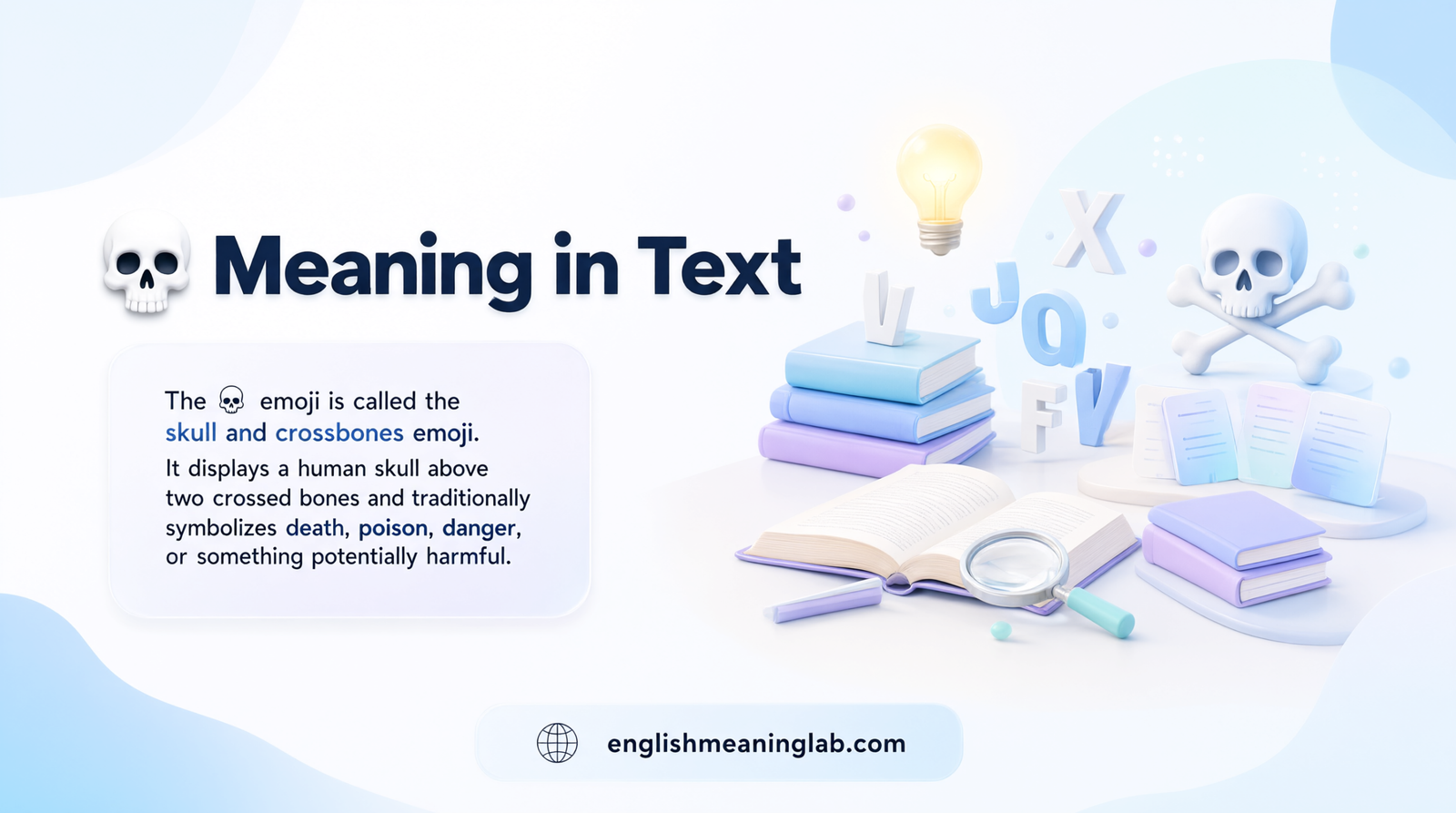
The ☠️ emoji is called the skull and crossbones emoji. It displays a human skull above two crossed bones and traditionally symbolizes death, poison, danger, or something potentially harmful.
However, its meaning has expanded in digital conversations. Many people now use it as an exaggerated reaction to funny, awkward, shocking, or unbelievable situations.
What does ☠️ represent in texting?
In everyday messaging, the emoji can communicate several different feelings:
1. Extreme laughter
One of its popular informal uses is to express that something is extremely funny.
Example:
Friend: “I accidentally waved back at someone who wasn’t waving at me.”
You: “☠️☠️”
Here, the emoji communicates that you find the situation hilarious.
2. Shock or disbelief
People sometimes use ☠️ when something is so surprising that they do not know what to say.
Example:
“She really said that in front of everyone ☠️”
The emoji emphasizes how shocking or unbelievable the situation was.
3. Embarrassment
It can also represent a moment of extreme awkwardness.
Example:
“I called my teacher mom in front of the whole class ☠️”
The sender is using the emoji to express embarrassment and humor.
4. Dark humor
Some people use the skull emoji when making jokes about unfortunate, uncomfortable, or exaggerated situations.
Example:
“Monday morning after sleeping for three hours ☠️”
The emoji makes the statement sound dramatically funny.
5. Danger or death
In a more literal context, ☠️ can symbolize poison, death, toxic substances, or serious danger.
Example:
“Keep away from this container ☠️”
Here, it may communicate a genuine safety warning rather than humor.
Does ☠️ always mean death?
No. Although death and danger are its traditional associations, its meaning in casual online communication is often humorous or exaggerated.
For example, if someone sends you a funny video followed by ☠️, they probably are not talking about death. They are expressing a strong reaction to the content.
The best way to understand it is to consider the message before the emoji and the relationship between the people communicating.
2. Background: Where Did the ☠️ Emoji Come From?
The skull and crossbones symbol has a much older history than modern smartphones and social media. It has traditionally been associated with death, poison, danger, and warnings.
The symbol became recognizable through its use in warning signs, illustrations, and other visual communication. Its simple design makes it easy to understand even when people speak different languages.
Historical symbolism of the skull and crossbones
For a long time, skull imagery has been connected with mortality and the idea that life is temporary. When crossed bones were added beneath a skull, the combination became a recognizable symbol associated with death and danger.
It has also appeared in traditional pirate imagery, where skull-and-crossbones flags became associated with piracy and intimidation.
In warning contexts, the symbol has been used to identify poisonous or toxic substances. This is why people may still interpret it seriously when they see it on a chemical container or safety label.
How it became a digital emoji
As digital communication developed, familiar symbols became part of emoji collections. The skull and crossbones design was introduced into the Unicode emoji system, allowing people to use it across supported digital platforms.
It gradually became more than a literal warning symbol.
People began using skull imagery in humorous online reactions, particularly when they wanted to exaggerate their response to something funny, shocking, or embarrassing.
How social media changed its meaning
Social media helped popularize the humorous use of skull emojis.
Instead of writing:
- “That was incredibly funny.”
- “I cannot believe what happened.”
- “I’m so embarrassed.”
Someone might simply send:
“☠️”
This shorter reaction communicates an exaggerated emotional response.
Today, the emoji has both traditional and modern meanings. It can represent danger in serious situations and laughter in casual conversations. Neither interpretation should automatically replace the other.
3. Usage in Different Contexts
The ☠️ emoji can communicate different messages depending on where it appears. Its meaning is strongly influenced by the conversation, the sender’s personality, and the situation.
☠️ in chat messages
In private conversations, the emoji is frequently used as a reaction to something funny, surprising, or embarrassing.
Example:
Person A: “I sent a message about my boss directly to my boss.”
Person B: “NO WAY ☠️”
The second person is expressing shock and probably finding the situation funny.
It can also be used when someone wants to exaggerate how difficult or exhausting something feels.
☠️ on social media
On social media, the emoji often appears in comments, captions, and reactions.
For example:
- “This video ended me ☠️”
- “That outfit is confused☠️”
- “I wasn’t expecting that ending ☠️”
- “The comments are killing me ☠️”
These expressions are usually figurative. They communicate strong amusement, surprise, or disbelief rather than literal harm.
☠️ in professional communication
The skull and crossbones emoji is generally unsuitable for formal workplace communication unless the conversation is informal and the participants understand the intended tone.
In professional or technical environments, it may have a literal safety-related meaning.
For example, a skull and crossbones symbol on a chemical warning label can indicate acute toxicity.
In workplace documents, safety instructions, or official messages, it is important not to interpret the symbol as a joke without considering the context.
☠️ in casual conversations
Friends frequently use the emoji to react dramatically to ordinary situations.
Examples:
- “I forgot my homework again ☠️”
- “That exam was impossible ☠️”
- “My phone died at the worst time ☠️”
- “I laughed so hard at that joke ☠️”
In these situations, the emoji adds humor and exaggeration.
☠️ as a sarcastic reaction
Sometimes people use the skull emoji to communicate sarcasm or disbelief.
For example:
“Yeah, because that’s exactly what I needed today ☠️”
The emoji adds a dramatic tone that suggests the situation is frustrating or ridiculous.
The surrounding words help determine whether the sender is joking, annoyed, or genuinely concerned.
4. ☠️ Meaning in Chat, WhatsApp, Instagram, and TikTok
Although the skull and crossbones emoji has a recognizable basic design, people use it in different ways across messaging apps and social platforms.
☠️ meaning in chat
In ordinary chat conversations, ☠️ is often a reaction to something extremely funny, awkward, or surprising.
Example:
Friend: “I forgot I was on mute and talked for five minutes.”
You: “☠️ That’s embarrassing!”
The emoji communicates amusement and disbelief.
It can also be used alone when the sender wants to react without typing a complete sentence.
☠️ meaning on WhatsApp
On WhatsApp, people use ☠️ in individual conversations, group chats, and status replies.
Examples:
- “Bro, that joke was too much ☠️”
- “I have three exams tomorrow ☠️”
- “You actually did that? ☠️”
- “This group chat is wild ☠️”
In a group conversation, it can become a shared reaction to a funny message or unexpected event.
However, when used in conversations about poison, injuries, or dangerous situations, its literal meaning may be more relevant.
☠️ meaning on Instagram
On Instagram, the skull emoji often appears in comments, reels, stories, and direct messages.
Examples:
- “This reel is killing me ☠️”
- “The last part got me ☠️”
- “That comment section ☠️”
- “I can’t stop laughing ☠️”
It is frequently used as an exaggerated reaction to entertaining or unexpected content.
☠️ meaning on TikTok
TikTok users often use ☠️ in comments and captions to react to funny videos, relatable situations, and unexpected moments.
For example:
“POV: You studied everything except the chapter that came in the exam ☠️”
Here, the emoji represents frustration mixed with humor.
Another example:
“Not him saying that with a straight face ☠️”
This communicates disbelief and amusement.
☠️ meaning on Snapchat
On Snapchat, the emoji may appear in snaps, private chats, or reactions to stories.
For example:
“Your picture from yesterday ☠️”
Depending on the relationship, this could be a playful reaction to an awkward or funny photograph.
If the sender regularly jokes with you, the emoji may simply be part of their usual communication style.
Does the meaning change across platforms?
The basic symbolism remains similar, but platform culture can influence how frequently people use it humorously.
In casual messaging, it often represents laughter or shock. In safety-related information, it can retain its traditional meaning of death or toxicity.
5. ☠️ Meaning in Physics, Medical, and Aircraft Terminology
The skull and crossbones emoji has recognizable safety symbolism, but it does not have one universal technical definition across every scientific or professional field.
☠️ in physics
The skull and crossbones emoji is not a standard physics symbol used to represent a specific physical quantity, equation, or scientific law.
However, the symbol may appear in physics-related educational material discussing radioactive substances, hazardous chemicals, or laboratory safety.
Its presence would generally communicate a safety concern rather than identify a physics formula.
☠️ in medical terminology
The skull and crossbones symbol is associated with toxicity and poison warnings.
In medical and health-related contexts, it may appear on educational materials, chemical labels, or safety information to indicate that a substance can cause serious harm if exposure occurs.
However, the emoji itself is not a medical diagnosis, disease name, or standardized clinical abbreviation.
For example:
“Keep this substance away from children ☠️”
In this context, it communicates a warning about potential toxicity.
☠️ in aircraft and aviation terminology
The emoji is not a universal aviation abbreviation or standard aircraft communication symbol.
However, skull imagery may appear in military, historical, or decorative aviation contexts, including certain unit insignia and artwork.
It should not be confused with standardized aviation warning symbols, cockpit indicators, or emergency communication terminology.
Why context is important
The skull and crossbones symbol can have a serious safety meaning outside social media.
For example:
- In a funny text, it may represent extreme laughter.
- On a toxic chemical label, it warns of poisoning hazards.
- In an online discussion, it may express shock or dark humor.
- In an aviation illustration, it may be decorative or represent a particular emblem.
Always consider where the symbol appears before deciding what it means.
6. Common Misconceptions About the ☠️ Emoji
The skull and crossbones emoji is easy to misunderstand because its traditional meaning is different from some of its popular internet uses.
Here are some common misconceptions.
Misconception 1: ☠️ Always means death
This is not true. Although the symbol traditionally represents death and danger, it is frequently used humorously in modern texting.
If someone sends ☠️ after a funny joke, they are probably expressing laughter rather than referring to actual death.
Misconception 2: ☠️ Always means someone is angry
The emoji does not automatically communicate anger.
It may express shock, embarrassment, amusement, frustration, or sarcasm. The words surrounding it provide important clues about the sender’s emotional state.
Misconception 3: ☠️ and 💀 always have exactly the same meaning
Both emojis feature skull imagery and can be used to communicate extreme laughter or shock.
However, ☠️ includes crossed bones and has a stronger traditional association with poison and danger. 💀 is often used more casually as a reaction to something hilarious or overwhelming.
Misconception 4: Sending ☠️ is always negative
A skull emoji may look frightening, but its use is not necessarily hostile or threatening.
Friends often use it to react to jokes, funny mistakes, and unexpected situations.
For example:
“Your dance moves ☠️”
This could be playful teasing rather than an insult.
Misconception 5: ☠️ means someone is threatening you
An emoji alone is not enough to establish a threat.
However, if it appears alongside threatening language, references to violence, or other concerning messages, it should be taken seriously rather than dismissed as internet slang.
Misconception 6: The emoji has one fixed meaning on every platform
Its traditional symbolism is recognizable, but its conversational meaning changes with context.
A humorous comment, a safety warning, and a dark joke can all use the same emoji for different purposes.
7. Similar Emojis and Alternatives
Several emojis can communicate feelings similar to ☠️. However, each one has its own tone and common use.
| Emoji | Common meaning | Typical use |
|---|---|---|
| ☠️ | Death, danger, extreme laughter | Dark humor, shock, safety warnings |
| 💀 | Skull, extreme laughter, disbelief | Funny or shocking reactions |
| 😂 | Laughing with tears | Something genuinely funny |
| 🤣 | Rolling on the floor laughing | Very strong laughter |
| 😭 | Crying or exaggerated emotional reaction | Sadness, laughter, frustration |
| 😵 | Dizziness or being overwhelmed | Confusion or shock |
| 😱 | Fear, surprise, or shock | Unexpected situations |
| ⚰️ | Coffin, death | Dark humor or literal death-related topics |
| 🪦 | Gravestone | Remembrance, death-related references |
☠️ vs. 💀
These are the two most closely related emojis.
Both can communicate dark humor, death-related themes, or extreme laughter.
However, 💀 is commonly used as a casual reaction to something hilarious, while ☠️ visually emphasizes poison, danger, and the traditional skull-and-crossbones symbol.
Example:
“That joke was confused💀”
“That joke was so dark ☠️”
The distinction is not absolute, because people often use both interchangeably.
☠️ vs. 😂
The laughing emoji 😂 directly communicates laughter.
The skull emoji ☠️ can communicate laughter in a more exaggerated, sarcastic, or dramatic way.
For example:
“That video is funny 😂”
“That video ended me ☠️”
Both express amusement, but the second sounds more exaggerated.
☠️ vs. 😭
The crying emoji 😭 can express sadness, but it is also frequently used to communicate overwhelming laughter or emotion.
The skull emoji is often associated with dark humor and dramatic reactions.
Example:
“Why would you say that 😭”
“Why would you actually do that ☠️”
Both may communicate disbelief, but their tone depends on the conversation.
☠️ vs. 😵
The dizzy-face emoji 😵 often represents confusion, exhaustion, or feeling overwhelmed.
The skull emoji can also communicate an overwhelming reaction, but it has additional associations with death and danger.
8. How to Respond to the ☠️ Emoji
Your response depends on why the other person sent the emoji. If it appears after a funny message, a playful reply is usually appropriate. If it appears in a serious conversation, you should consider the possibility of a genuine warning or concern.
If someone sends ☠️ after a joke
You can respond with another humorous message.
Examples:
- “I knew you’d laugh!”
- “It was too funny 😂”
- “I couldn’t help myself!”
- “I’m crying too 😭”
These responses keep the conversation light.
If someone sends ☠️ after an embarrassing story
You can acknowledge the awkwardness without becoming defensive.
Examples:
- “Don’t remind me!”
- “I still can’t believe that happened.”
- “That was my worst moment!”
- “Never speaking about that again ☠️”
If someone sends ☠️ because they are shocked
You can explain what happened or continue the conversation.
Examples:
- “I know, right?”
- “Even I wasn’t expecting that.”
- “It gets worse!”
- “Wait until you hear the rest.”
If someone sends ☠️ in a serious conversation
Do not automatically assume they are joking.
If the conversation involves dangerous substances, threats, injuries, or other serious issues, ask what they mean.
Examples:
- “Are you serious?”
- “Is everything okay?”
- “What happened?”
- “Are you warning me about something?”
If you do not understand the emoji
You can simply ask for clarification.
For example:
- “What does that mean? 😂”
- “Are you laughing or shocked?”
- “Why the skull emoji?”
A simple question can prevent misunderstandings, especially when communicating with someone whose texting style is unfamiliar.
9. Differences Between ☠️ and Similar Expressions
The skull and crossbones emoji can replace several written reactions, but it does not communicate exactly the same thing as every related expression.
☠️ vs. “I’m dead”
“I’m dead” is a common figurative expression used when something is extremely funny, shocking, or embarrassing.
For example:
“That video was so funny, I’m dead.”
The ☠️ emoji can communicate the same exaggerated reaction without writing the phrase.
However, both expressions can also be used literally in serious conversations, depending on context.
☠️ vs. “I’m dying”
“I’m dying” is another exaggerated expression that often means someone is laughing extremely hard or struggling with an overwhelming situation.
For example:
“Stop making me laugh, I’m dying!”
The skull emoji can represent a similar reaction, particularly in informal messages.
☠️ vs. “That killed me”
“That killed me” usually means something was extremely funny, embarrassing, or emotionally overwhelming.
The skull emoji can serve as a short visual reaction to the same kind of situation.
Neither expression should automatically be interpreted literally in a casual conversation.
☠️ vs. “LOL”
LOL means “laughing out loud” and is commonly used to indicate amusement.
The skull emoji often communicates a stronger or more exaggerated reaction, especially when something is unexpectedly funny.
For example:
“LOL, that’s funny.”
“That was absolutely ridiculous ☠️”
☠️ vs. “RIP”
RIP stands for “Rest in Peace” and is traditionally used when referring to someone who has died.
In online conversations, RIP can also be used humorously to describe something that has failed or ended.
The skull emoji can communicate a similar dramatic feeling, but it has a broader range of meanings.
10. ☠️ in Online Conversations and Dating Apps
The skull emoji can appear in conversations between friends, romantic partners, people who are dating, and strangers interacting online.
Its meaning in these situations depends on the relationship and the tone of the conversation.
When someone uses ☠️ while flirting
A person might use the emoji when they find something you said unexpectedly funny or embarrassing.
Example:
You: “I practiced what to say before messaging you.”
Them: “That’s actually cute ☠️”
Here, the emoji may communicate playful surprise or amusement.
It does not necessarily mean the person is making fun of you.
When your crush sends ☠️
If your crush sends the skull emoji after a funny message, they are probably reacting to your humor or something surprising you said.
For example:
You: “I accidentally liked their picture from three years ago.”
Crush: “NOOO ☠️”
This response suggests amusement and embarrassment about the situation.
However, it does not automatically indicate romantic interest.
When someone uses ☠️ on a dating app
On dating apps, the emoji may appear in conversations about awkward first dates, funny experiences, unusual profiles, or unexpected messages.
Example:
“Your opening line actually made me laugh ☠️”
The sender is probably expressing amusement or playful surprise.
When a partner sends ☠️
A romantic partner may use the emoji when reacting to your jokes, mistakes, or exaggerated statements.
For example:
“You really ordered five desserts? ☠️”
This may communicate playful disbelief rather than criticism.
Can ☠️ be a sign of flirting?
Sometimes, but the emoji alone is not a reliable sign of attraction.
A person might use it because they find your message funny, enjoy joking with you, or want to keep the conversation entertaining.
Look at the broader interaction, including whether they initiate conversations, show personal interest, and make an effort to spend time with you.
The most accurate interpretation comes from understanding the conversation rather than assigning romantic meaning to one emoji.
FAQs
1. What does ☠️ mean in text from a girl?
When a girl sends ☠️, she may be expressing extreme laughter, shock, embarrassment, or disbelief. If she sends it after a funny message, it probably means she finds something hilarious. The emoji does not automatically indicate anger, dislike, or romantic interest. The surrounding conversation helps determine her intended meaning.
2. What does ☠️ mean from a guy?
When a guy uses ☠️ in a casual text, he is often reacting to something funny, surprising, or embarrassing. It may communicate that he is laughing extremely hard or cannot believe what happened. In a serious conversation, however, it can retain its traditional association with death or danger.
3. Does ☠️ mean laughing or crying?
The ☠️ emoji is often used to represent extreme laughter, especially in internet slang. It can also communicate shock, embarrassment, or disbelief. Although people sometimes use it alongside crying emojis, its primary humorous interpretation is that something is so funny or overwhelming that the sender is dramatically reacting.
4. What does ☠️ mean on Instagram and TikTok?
On Instagram and TikTok, ☠️ commonly appears in comments, captions, and reactions to funny videos or unexpected situations. It often means that something is hilarious, shocking, or extremely embarrassing. It can also be used in dark humor, memes, and dramatic reactions, depending on the content.
5. What is the difference between ☠️ and 💀?
Both emojis can represent death, dark humor, shock, and extreme laughter. However, 💀 is commonly used as a casual reaction to something hilarious, while ☠️ includes crossed bones and has a stronger traditional association with poison and danger. In everyday texting, people sometimes use them interchangeably.
6. Does ☠️ mean someone is threatening me?
Not necessarily. The emoji is often used humorously in casual conversations and does not automatically represent a threat. However, if it appears alongside threatening statements, references to violence, or other concerning messages, take the situation seriously. Consider the sender’s words and behavior rather than judging the emoji alone.
7. How do you reply when someone sends ☠️?
You can respond with humor if the emoji follows a funny or embarrassing message. For example, say “I know, right? 😂” or “I can’t stop laughing either.” If you are unsure why someone sent it, ask what they mean. In serious conversations, clarify whether they are expressing a genuine warning or concern.
8. Does ☠️ have a romantic meaning?
The skull and crossbones emoji does not have an established romantic meaning by itself. Someone might use it while flirting or joking with a romantic partner, but it generally communicates laughter, shock, or dramatic emotion. Look at the surrounding conversation to understand whether the interaction is romantic, friendly, or simply humorous.
Conclusion
The ☠️ emoji, commonly known as the skull and crossbones, has both traditional and modern meanings. Traditionally, it represents death, poison, and danger. In modern texting and social media conversations, however, it is frequently used to express extreme laughter, shock, embarrassment, disbelief, or dark humor.
People use it across WhatsApp, Instagram, TikTok, Snapchat, and other platforms to react dramatically to funny videos, awkward situations, unexpected messages, and unusual experiences. Its meaning can also change when it appears in professional, medical, or safety-related contexts.
The most important thing to remember is that ☠️ does not always represent something negative or frightening.
Sometimes, it simply means that someone finds a situation incredibly funny. Before interpreting the emoji, consider the surrounding message, the sender’s personality, and your relationship with them. Understanding these details will help you recognize whether the emoji communicates humor, surprise, danger, or another emotion.