Have you ever received a message containing “WRD” and wondered what the sender was trying to say? Short abbreviations are common in digital communication because they help people respond quickly without typing complete sentences. However, some abbreviations can be confusing when you encounter them for the first time.
The WRD meaning slang most commonly relates to “word,” an informal expression used to show agreement, acknowledgment, or understanding in a conversation.
Depending on the context, it can communicate a response similar to “true,” “exactly,” “I agree,” or “for real.” People may use it when chatting with friends, reacting to a statement, or responding to something surprising.
WRD is particularly useful to understand in casual texting and social media conversations, where people often shorten familiar words.
However, its meaning can vary depending on the conversation, the people involved, and the way it is written. Learning how WRD works can help you understand messages more confidently and choose an appropriate response.
Quick Answer
WRD is an informal abbreviation of “word” commonly used in texting and online conversations. It can express agreement, acknowledgment, or recognition of something someone has said, similar to “true” or “exactly.” In some contexts, it can also function as a quick reaction meaning “for real?” The surrounding conversation helps determine its intended meaning.
1. Meaning and Definition of WRD
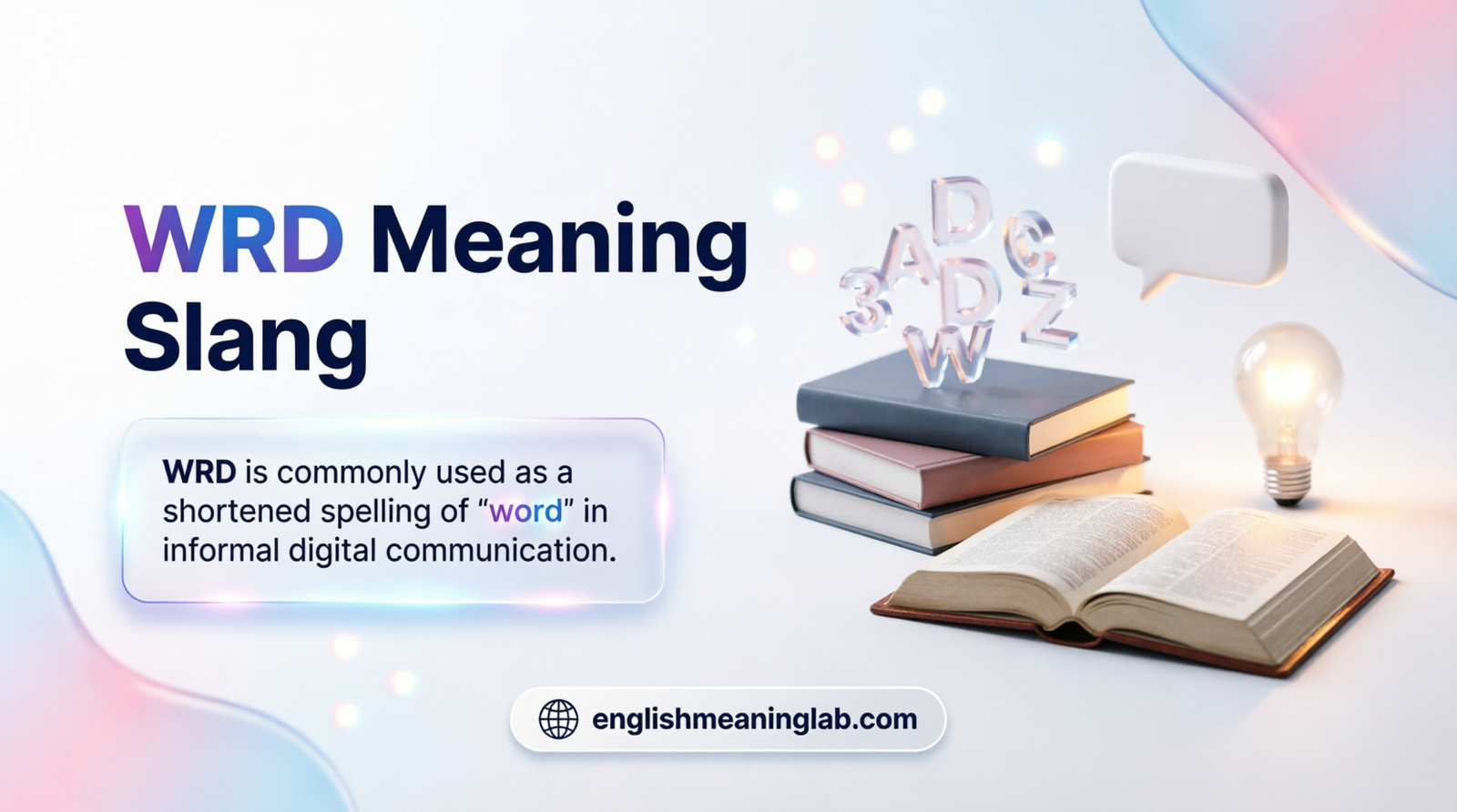
WRD is commonly used as a shortened spelling of “word” in informal digital communication. People may use it to agree with someone, acknowledge a statement, or show that they understand what another person means.
In slang conversations, “word” can communicate more than the literal meaning of the word itself. It can act as a short response that confirms a point or shows that the speaker relates to what was said.
For example:
Person A: “That movie was actually amazing.”
Person B: “WRD.”
Here, WRD communicates agreement, similar to saying, “I agree” or “That’s true.”
What does WRD mean in a text?
In a text message, WRD most often functions as a casual acknowledgment or agreement.
Examples include:
- “WRD, that was a great game.”
- “WRD bro, I was thinking the same thing.”
- “WRD, today was exhausting.”
- “That song is so good.” — “WRD.”
In these examples, the sender uses WRD to show that they agree with or understand the other person’s statement.
Can WRD mean “for real”?
Sometimes, WRD can be used as a reaction to something surprising or difficult to believe. The intended meaning may resemble “for real?” or “seriously?”
For example:
Person A: “He finished the entire project in one night.”
Person B: “WRD?”
The question mark suggests surprise or a request for confirmation. However, WRD is not universally understood as a direct abbreviation of “for real.” In many conversations, it still refers to “word,” with the exact tone supplied by the context.
Is WRD positive or negative?
WRD is generally neutral or positive when used to agree with someone. It can show support, understanding, or shared feelings.
Its tone depends on the statement it responds to. If someone complains about a difficult day, WRD may communicate sympathy or agreement. If someone makes an exciting announcement, it may show enthusiasm or surprise.
The key is to read the entire exchange instead of interpreting the abbreviation in isolation.
2. Background: Where Did WRD Come From?
WRD is associated with the informal use of “word” in everyday speech and online communication. The shortened spelling removes the vowel, making the expression quicker to type while preserving a recognizable form of the original word.
There is no single, reliably established origin date for WRD as a texting abbreviation. It is better to understand it as part of the broader habit of shortening familiar words in digital conversations rather than attributing its creation to a specific person or platform.
The role of informal speech
The word “word” has long been used conversationally as an expression of acknowledgment or agreement in some varieties of informal English.
For example, a person might respond “Word” to indicate that they agree with a statement or recognize its truth. WRD carries a similar function in some online conversations.
The shortened version fits naturally into brief text exchanges because it communicates a response without requiring a complete sentence.
How texting encouraged abbreviations
Text messaging and online chats made abbreviated spellings common. People frequently shorten words when communicating with friends or participating in fast-moving conversations.
WRD follows this pattern by using three letters instead of spelling out “word.” Like many informal spellings, it is most appropriate when the participants understand the style of communication.
Social media and online conversations
Social media comments, group chats, and direct messages provide settings where short reactions are especially useful.
For example:
Post: “Nobody talks about how difficult Mondays are.”
Comment: “WRD.”
The commenter is agreeing with the sentiment rather than referring to a literal word.
Why people still use WRD
WRD is brief, casual, and easy to recognize for people familiar with this style of slang. It may also match the tone of a conversation where participants use other short expressions.
However, slang varies among communities, and not everyone interprets every abbreviation in the same way. Some people may prefer “true,” “facts,” or “fr” instead.
Because WRD does not have one meaning in every possible situation, its origin and everyday function should be distinguished from any specialized use of the same letters.
3. Usage in Different Contexts
WRD is most recognizable in informal communication, but the way it is understood depends on the situation.
WRD in chat
In private chats, WRD commonly expresses agreement or acknowledgment.
Example:
Friend 1: “We seriously need a vacation.”
Friend 2: “WRD.”
The second friend is agreeing that a vacation would be welcome.
It can also be used as a brief response when someone shares an opinion, experience, or observation.
WRD on social media
On social media, WRD may appear in comments or replies to show agreement with a post.
Example:
Post: “Good friends make difficult days easier.”
Comment: “WRD.”
The commenter is expressing agreement with the statement.
Because comments are often short, abbreviations help users react without writing a lengthy response.
WRD in professional communication
WRD is generally unsuitable for formal professional writing. In an email, report, or official workplace message, it may look unclear or overly casual.
Instead of writing “WRD,” a professional response could be:
- “I agree.”
- “That’s correct.”
- “Understood.”
- “I see your point.”
In an informal workplace chat between familiar colleagues, WRD might appear occasionally, but it is best used only when the conversational style makes its meaning clear.
WRD in casual conversations
Among friends, WRD can help maintain a relaxed conversational tone.
Example:
Person A: “That restaurant is way too expensive.”
Person B: “WRD, the prices are confused .”
Here, the abbreviation reinforces agreement and keeps the conversation informal.
WRD as a reaction to surprising news
Depending on the writer’s style, WRD followed by a question mark may signal surprise or disbelief.
Example:
Person A: “She got the job after only one interview.”
Person B: “WRD?”
The question mark suggests that the sender wants confirmation or finds the news surprising. If the meaning is unclear, asking “Do you mean for real?” can resolve the ambiguity.
4. WRD Meaning in Chat, WhatsApp, Instagram, and TikTok
WRD may appear across messaging apps and social platforms as a quick reaction, but its meaning is not determined by the platform itself.
WRD meaning in chat
In a regular chat, WRD often means “word” and communicates agreement.
Example:
Message: “That was the best match of the season.”
Reply: “WRD.”
The sender is agreeing with the opinion.
WRD meaning on WhatsApp
On WhatsApp, WRD can appear in one-to-one conversations or group chats.
Examples:
- “This week has been so stressful.” — “WRD.”
- “We should all meet up this weekend.” — “WRD bro.”
- “That was a confused ending.” — “WRD?”
The first two examples suggest agreement. The last one may express surprise or ask for confirmation, depending on the conversation.
WRD meaning on Instagram
On Instagram, WRD can be used in comments or direct messages to acknowledge someone’s opinion.
For example:
Caption: “Sometimes staying home is better than going out.”
Comment: “WRD.”
This indicates that the commenter agrees with the sentiment.
It may also be used in direct messages when friends are discussing a video, photograph, or personal experience.
WRD meaning on TikTok
On TikTok, WRD may appear in comments responding to relatable videos, jokes, opinions, or personal stories.
Example:
Video: A person describes how difficult it is to wake up early every morning.
Comment: “WRD, mornings are the worst.”
The commenter is expressing agreement.
Does WRD have a special meaning on these platforms?
There is no single platform-specific meaning that applies to every use of WRD. Its common slang interpretation remains connected to “word,” agreement, and acknowledgment.
The surrounding words, punctuation, and tone can affect the interpretation. A plain “WRD” may express agreement, while “WRD?” can suggest surprise or a request for confirmation.
5. WRD Meaning in Physics, Medical, and Aircraft Terminology
WRD is commonly encountered as informal slang, but the same letters may appear in technical documents or specialized professional settings.
WRD in physics
WRD does not have one universally recognized meaning as a standard physics term.
Physics uses defined symbols, abbreviations, and units that depend on the subject being studied. If WRD appears in a physics textbook, laboratory note, or research paper, its meaning should be established from the surrounding material or the document’s glossary.
It would be misleading to assign it a specific scientific definition without supporting context.
WRD in medical terminology
WRD is not a universally standardized medical abbreviation with one meaning across all healthcare settings.
Medical abbreviations can differ among specialties, hospitals, and types of documentation. If WRD appears in a medical report, do not assume that it means the slang word “word.”
Check the surrounding information or ask a qualified healthcare professional to clarify an unfamiliar abbreviation when it affects your understanding of a medical document.
WRD in aircraft and aviation terminology
WRD does not have one universally established meaning across all aviation terminology.
Aircraft manuals and aviation documents may contain abbreviations specific to a manufacturer, organization, system, or procedure. If WRD appears in such a document, its meaning should be confirmed through the relevant documentation rather than guessed from internet slang.
Why context matters in technical writing
The same sequence of letters can have different uses depending on the field. Informal texting meanings should not automatically be applied to scientific, medical, or aviation contexts.
Capitalization can provide a clue, but it is not enough to establish a technical definition by itself. The subject, sentence, and official glossary are more useful when identifying an abbreviation in a specialized document.
6. Common Misconceptions About WRD
Because WRD is short and informal, people may interpret it differently or confuse it with other abbreviations.
Misconception 1: WRD always means “for real”
WRD can sometimes communicate surprise or a request for confirmation, especially when followed by a question mark. However, its common slang association is with “word,” which may express agreement or acknowledgment.
The surrounding conversation determines which interpretation makes the most sense.
Misconception 2: WRD is always a question
WRD does not need a question mark to make sense.
For example, “WRD, that movie was great” is a statement of agreement. “WRD?” may instead communicate surprise or ask whether something is true.
Punctuation can change the tone without necessarily changing the underlying expression.
Misconception 3: WRD is a formal abbreviation
WRD is generally an informal spelling used in casual digital communication. It is not a standard replacement for “word” in formal essays, professional reports, or official correspondence.
In formal settings, writing the complete word or sentence is usually clearer.
Misconception 4: Everyone understands WRD
Not everyone is familiar with the same slang. Someone who rarely uses texting abbreviations may not recognize WRD or may assume it is a typo.
If clarity matters, use a complete phrase such as “I agree” or “That’s true.”
Misconception 5: WRD always expresses strong agreement
WRD can indicate agreement, but the strength of that agreement depends on the conversation.
A simple “WRD” might be a casual acknowledgment rather than an enthusiastic endorsement. It is best not to infer strong emotions from a short response alone.
Misconception 6: WRD has the same meaning in every field
The slang interpretation does not automatically apply to professional or technical documents. In a specialized context, WRD may have a separate meaning defined by the organization or document.
Always consider the subject matter before interpreting an unfamiliar abbreviation.
7. Similar Terms and Alternatives
Several other slang expressions can communicate agreement, acknowledgment, or surprise. Some are similar to WRD, but their meanings are not exactly the same.
| Term | Common meaning | Typical use |
|---|---|---|
| WRD | Shortened form of “word” | Agreement or acknowledgment |
| FR | For real | Emphasizing truth or asking for confirmation |
| Facts | That is true | Strong agreement |
| True | Correct or accurate | Agreement |
| IKR | I know, right? | Shared agreement or reaction |
| Bet | Okay, agreed, or understood | Acceptance or confirmation |
| NGL | Not gonna lie | Introducing an honest opinion |
| TBH | To be honest | Expressing a candid view |
| IMO | In my opinion | Introducing a personal viewpoint |
WRD vs. FR
FR means “for real.” It can emphasize that something is true or express surprise when used as a question.
WRD is more closely associated with “word” and agreement.
Example:
- “WRD, that was difficult.” — Agreement.
- “FR? You finished already?” — Surprise or a request for confirmation.
WRD vs. facts
Facts is a common way to express strong agreement with a statement.
For example:
Person A: “Getting enough sleep makes a difference.”
Person B: “Facts.”
WRD can serve a similar purpose, although its tone may feel more casual or conversational.
WRD vs. IKR
IKR means “I know, right?” It commonly communicates agreement with a statement while suggesting that the speaker shares the same observation or feeling.
WRD can also acknowledge agreement, but IKR more explicitly conveys a shared reaction.
WRD vs. bet
Bet can mean “okay,” “agreed,” or “you can count on it,” depending on the conversation.
For example:
Person A: “Meet me at six.”
Person B: “Bet.”
This indicates acceptance of the plan. WRD would be less natural in this situation unless the conversation specifically called for agreement with an opinion.
8. How to Respond to WRD
The best response depends on what the other person is saying. Since WRD commonly expresses agreement, you often do not need to explain anything or ask what it means.
If someone agrees with you
You can continue the conversation naturally.
Examples:
- “Exactly!”
- “Glad you agree.”
- “That’s what I’m saying.”
- “For real.”
- “You get it.”
These responses work well when WRD is being used to confirm an opinion.
If someone uses WRD to react to a joke
You can keep the tone light.
Examples:
- “Haha, right?”
- “I knew you’d understand.”
- “No lies told.”
- “It’s too true.”
Choose a reply that fits the humor and relationship.
If someone writes “WRD?”
If the abbreviation appears with a question mark, the person may be surprised or asking for confirmation.
Examples:
- “Yeah, seriously.”
- “Yep, that’s what happened.”
- “For real!”
- “I know, confused, right?”
If you are not sure whether they are asking a question, a brief clarification can help.
If you do not understand WRD
There is nothing wrong with asking for the meaning.
You could say:
- “What does WRD mean here?”
- “Do you mean ‘word’?”
- “Are you agreeing with me?”
These questions are useful when the conversation does not provide enough information.
If WRD appears in a professional message
If the meaning is unclear in a work-related conversation, it is better to ask for clarification rather than guess. A professional response such as “Could you clarify what you mean by WRD?” keeps the exchange clear and respectful.
9. Differences Between WRD and Similar Expressions
Although WRD, FR, facts, and bet can all appear in casual conversations, they perform different functions.
WRD vs. “word”
WRD is a shortened spelling of “word.” In slang, both can communicate agreement or acknowledgment.
For example:
- “Word, that was a good idea.”
- “WRD, that was a good idea.”
The first spells the word normally, while the second uses an informal abbreviation. The meaning is broadly similar in this context.
WRD vs. “for real”
“For real” can emphasize sincerity, truth, or surprise. WRD can communicate agreement, and in some contexts it may function as a surprised reaction.
However, the two are not exact substitutes in every sentence.
For example, “Are you for real?” directly questions whether something is true. “WRD?” may convey a similar reaction in a particular chat, but its interpretation is less explicit.
WRD vs. “facts”
Facts often signals stronger agreement with a statement, as though the speaker is emphasizing that the statement is unquestionably true.
WRD can also show agreement but may sound more like a quick acknowledgment.
Example:
Statement: “Practice makes you better.”
Response: “Facts.”
This emphasizes the truth of the statement. WRD could also be used, depending on the speaker’s style.
WRD vs. “bet”
Bet often communicates acceptance, confidence, or agreement to do something.
For example:
Person A: “I’ll send you the details tonight.”
Person B: “Bet.”
Here, the response means something like “Okay” or “Sounds good.”
WRD is usually more natural when reacting to an opinion or statement rather than confirming a plan.
WRD vs. “I agree”
“I agree” is a direct, standard English expression. WRD is shorter and more informal.
In a casual chat, WRD can make the exchange feel relaxed. In a formal email or professional discussion, “I agree” is usually clearer and more appropriate.
10. WRD in Online Conversations and Dating Apps
WRD may appear in dating-app messages, social media discussions, and conversations between people who are getting to know one another. Its meaning usually remains connected to agreement or acknowledgment, but the context can affect its tone.
WRD in flirting
Someone might use WRD while responding to a playful or flirtatious comment.
Example:
Person A: “We would probably have fun together.”
Person B: “WRD.”
The response may indicate agreement, but it does not necessarily prove romantic interest. It could simply mean the person agrees with the statement.
WRD in dating-app conversations
On dating apps, short replies are common when people are chatting casually. WRD can be used to acknowledge an opinion or show that two people share the same view.
For example:
Person A: “Good communication matters in a relationship.”
Person B: “WRD.”
Here, the response indicates agreement with the idea.
However, a single abbreviation does not reveal how interested someone is or whether they want a serious relationship.
WRD between friends
Friends often use WRD when discussing shared experiences, jokes, or everyday frustrations.
Example:
Friend 1: “We really need to stop leaving everything until the last minute.”
Friend 2: “WRD.”
The second friend is agreeing with the observation.
WRD in group chats
In group conversations, WRD can be a quick way to agree with a message without adding a long explanation. It may appear in discussions about entertainment, school, work, or everyday life.
How to interpret the tone
Look at the statement that WRD responds to, whether it includes punctuation, and how the person normally communicates.
If the sender frequently uses short slang expressions, WRD may simply be their usual conversational style. If the conversation is flirtatious, it might contribute to a playful exchange, but it should not be treated as proof of attraction.
When the intention matters, a clear follow-up question is more reliable than guessing from an abbreviation.
FAQs
1. What does WRD mean in text messages?
WRD commonly stands for “word” in informal texting. It is often used to agree with someone, acknowledge a statement, or show that the sender understands. For example, replying “WRD” to a friend’s opinion can mean “I agree” or “That’s true.” The exact tone depends on the surrounding conversation.
2. What does WRD mean from a girl or guy?
When a girl or guy sends WRD, it usually expresses agreement or acknowledgment. It does not automatically indicate flirting or romantic interest. If the conversation is playful or romantic, the abbreviation may be part of that tone, but the message itself is not enough to establish someone’s feelings.
3. Does WRD mean “for real”?
WRD can sometimes be used as a surprised reaction, particularly when written as “WRD?” However, its common slang association is with “word,” which can express agreement or acknowledgment. If the sender’s intention is unclear, consider the preceding message or ask whether they are expressing surprise or agreeing.
4. What does WRD mean on WhatsApp and Instagram?
On WhatsApp and Instagram, WRD commonly appears as a short response to an opinion, joke, or relatable statement. It usually indicates agreement or acknowledgment. For example, replying “WRD” to a message about a difficult day may mean “That’s true” or “I feel the same way.”
5. Is WRD a slang word or an abbreviation?
WRD is an informal shortened spelling of “word” rather than a conventional initialism in its common slang use. It is used mainly in casual digital communication, including texts, comments, and direct messages. In formal writing, spelling out the word or using a complete response is generally clearer.
6. How should I reply when someone texts WRD?
You can respond according to the conversation. If the person agrees with your opinion, you might say “Exactly,” “For real,” or “That’s what I’m saying.” If they appear surprised by writing “WRD?”, you can confirm what happened or explain your statement further. A natural response is usually enough.
7. Can WRD have more than one meaning?
Yes, the interpretation of WRD can depend on context. In casual slang, it commonly relates to “word” and agreement. A question mark may suggest surprise or a request for confirmation. In technical or professional documents, the same letters may be used differently, so the intended meaning should be checked rather than assumed.
8. Is WRD appropriate for professional messages?
WRD is generally too informal for formal emails, official reports, and professional documents. In a casual workplace chat, colleagues may understand it, but “I agree,” “That’s correct,” or “Understood” is usually clearer. If WRD appears in a technical document, consult the relevant context or glossary before interpreting it.
Conclusion
WRD is an informal slang abbreviation commonly associated with the word “word.” In texting and online conversations, it often expresses agreement, acknowledgment, or recognition of something another person has said. Depending on the context and punctuation, it may also serve as a reaction to surprising information.
People may use WRD in private messages, WhatsApp groups, Instagram comments, TikTok discussions, and casual conversations with friends. It is generally informal, so a complete phrase is usually more appropriate in professional communication.
The most important point is that WRD does not have one guaranteed interpretation in every situation. A plain response may indicate agreement, while a question mark can suggest surprise or a request for confirmation. Technical documents may also use the same letters in a different way.
When you encounter WRD, consider the surrounding message and the relationship between the people communicating. If its meaning remains unclear, asking a quick question is better than making an unsupported assumption.