Have you ever received a text message containing “MBN” and wondered what the sender was trying to say? Short abbreviations are common in online conversations because they help people communicate quickly without typing complete sentences. However, these shortened expressions can be confusing when you encounter them for the first time.
The phrase “what do MBN mean in text” is a common type of search from people trying to understand texting slang and social media language.
In everyday digital communication, MBN most commonly stands for “must be nice.” People use it when someone shares something enjoyable, exciting, or fortunate, such as a vacation, a new purchase, or a relaxing day off.
Depending on the conversation, MBN can express genuine happiness for someone, playful envy, sarcasm, or mild frustration. Understanding the situation helps you recognize the sender’s intended tone.
In this guide, you will learn how MBN works in text messages, WhatsApp chats, Instagram comments, TikTok conversations, and other settings, along with examples and natural ways to respond.
Quick Answer
MBN means “must be nice” in text messages and online conversations. It is commonly used when someone talks about something enjoyable or fortunate, such as a vacation, a new phone, or a day off. Depending on the context, MBN can express playful jealousy, sarcasm, admiration, or genuine appreciation.
1. Meaning and Definition of MBN
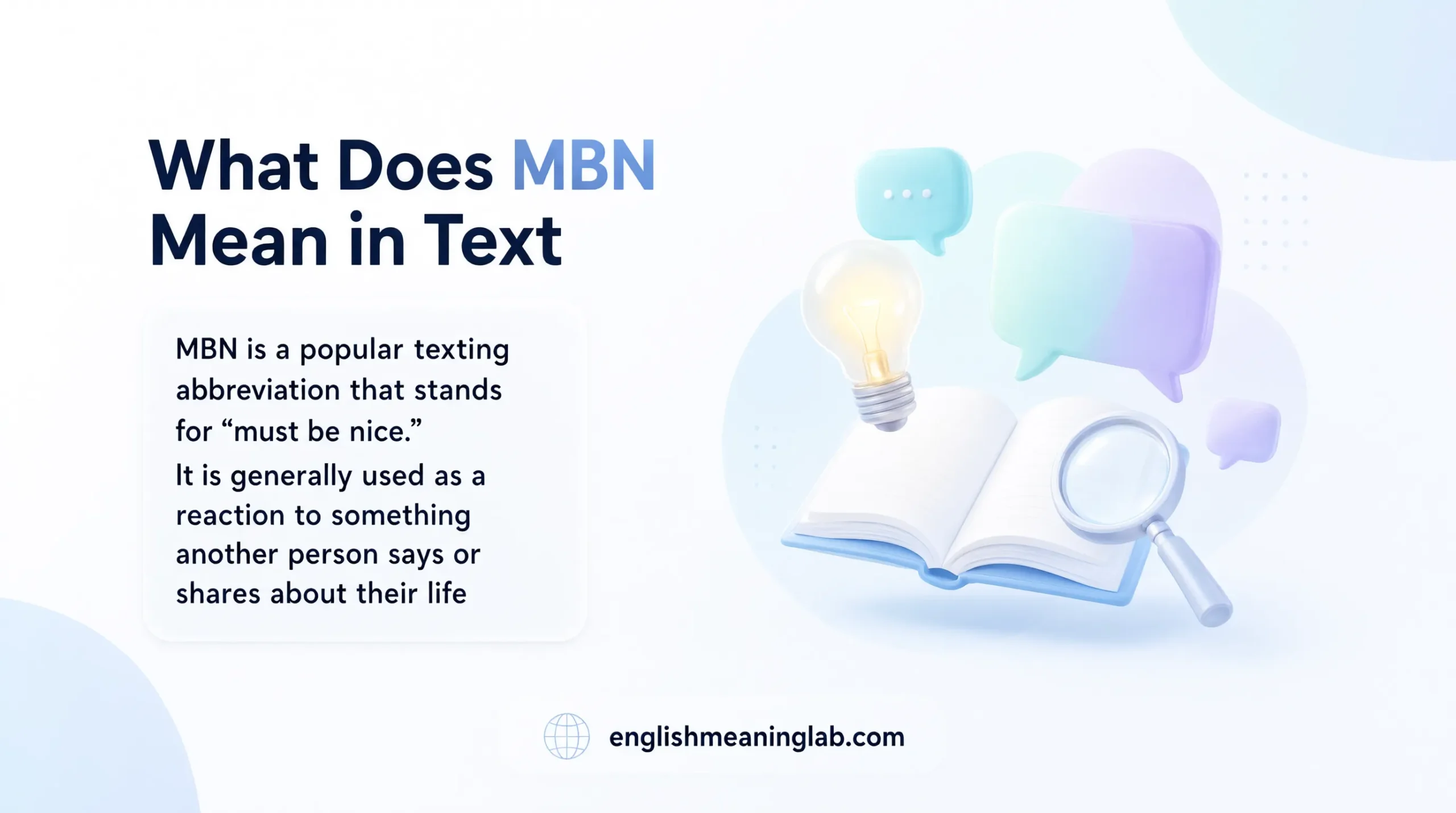
MBN is a popular texting abbreviation that stands for “must be nice.” It is generally used as a reaction to something another person says or shares about their life.
For example, if your friend tells you that they are spending the weekend at the beach while you have to work, you might reply, “MBN.” This communicates that their situation sounds enjoyable, especially compared with your own.
The expression can be friendly, humorous, sarcastic, or slightly envious. Its meaning depends on the conversation, the relationship between the people, and the tone of the surrounding messages.
What does “must be nice” actually mean?
In everyday English, “must be nice” suggests that another person’s experience seems pleasant, comfortable, or fortunate.
Consider these examples:
- “I slept until noon today.” — “MBN!”
- “We’re going on vacation next week.” — “MBN, have fun!”
- “My boss gave me Friday off.” — “MBN 😭”
- “I got the new phone yesterday.” — “MBN, I’m still using my old one.”
Each response reacts to something the other person gets to enjoy.
Can MBN be sarcastic?
Yes. MBN can sound sarcastic when the sender feels that someone else has an advantage they do not have.
For example:
Person A: “I don’t have to study because I already finished my assignments.”
Person B: “MBN.”
Person B may genuinely think the situation sounds great, or they may be jokingly frustrated because they still have work to do.
The abbreviation does not automatically indicate resentment. Friends often use it to tease one another without any serious negative feelings.
Is MBN always negative?
No. Although the phrase can express envy or sarcasm, it can also be a lighthearted compliment or a simple acknowledgment that someone is fortunate.
For example, “I finally got a week off work!” followed by “MBN, enjoy it!” sounds supportive rather than bitter.
The surrounding words, emojis, and relationship between the people help clarify the intended meaning. When the context is unclear, it is better not to assume that the sender is being rude.
2. Background: Where Did MBN Come From?
MBN developed as a shortened form of the everyday expression “must be nice.” Like many texting abbreviations, it makes a familiar phrase quicker to type in casual digital conversations.
There is no single, reliably established origin date or inventor for the abbreviation. It is best understood as part of the broader development of informal internet language.
How texting abbreviations became common
Text messaging encouraged people to shorten familiar expressions, especially when typing on mobile phones or communicating in quick exchanges.
Over time, abbreviations became a normal part of online conversations. People began using them not only to save typing time but also to establish a casual tone and communicate shared meanings efficiently.
MBN fits this pattern because “must be nice” is a relatively common reaction to another person’s good fortune.
How the phrase works in conversation
The full expression can communicate admiration, envy, or sarcasm without explaining those feelings directly.
For instance, if someone says they are spending the entire weekend relaxing, another person might respond with “Must be nice.”
The statement may simply acknowledge that the situation sounds enjoyable. Alternatively, it might imply, “I wish I could do that too.”
Shortening the phrase to MBN preserves this conversational function while making the response more compact.
Why people use MBN online
MBN is useful when someone wants to react quickly to a message, photograph, video, or announcement.
It can appear in conversations about:
- Holidays and travel.
- New purchases and gifts.
- Free time and relaxing weekends.
- Academic or professional achievements.
- Relationships and social activities.
- Everyday privileges or lucky situations.
The abbreviation is particularly suitable for informal conversations because its tone depends heavily on shared context.
Does MBN have one fixed emotional meaning?
No. The basic expansion is “must be nice,” but the emotional intention can vary.
A friend may use it jokingly, a family member may use it to express admiration, and someone who feels left out may use it sarcastically.
There is no need to assign a different expansion to every situation. Usually, the same phrase carries different tones rather than different literal meanings.
3. Usage in Different Contexts
MBN can appear in many types of communication. Its meaning generally remains “must be nice,” but the setting influences whether it sounds playful, appreciative, or sarcastic.
MBN in chat
In private chats, MBN is often a quick reaction to good news or an enjoyable experience.
Example:
Person A: “I finished all my work, so I’m watching movies tonight.”
Person B: “MBN 😂”
Person B is reacting to the opportunity to relax. The laughing emoji suggests that the response may be playful.
Another example:
Person A: “I’m visiting my cousins this weekend.”
Person B: “MBN! Have fun.”
Here, MBN sounds friendly and supportive.
MBN on social media
On social media, people may use MBN in comments or replies to posts showing vacations, expensive purchases, exciting events, or relaxing activities.
For example, someone posts a photograph from a beautiful holiday destination, and a friend comments, “MBN!”
The commenter is acknowledging that the trip looks enjoyable. Depending on their relationship, the remark might also express a little envy.
MBN in professional communication
MBN is informal slang and is generally unsuitable for formal business emails, official reports, or professional documents.
However, coworkers who have a casual relationship might use it in a private chat.
Example:
Coworker A: “I managed to take Monday off.”
Coworker B: “MBN!”
In this context, the abbreviation is a casual reaction to the other person’s free time. In a formal workplace exchange, a clearer response such as “That sounds like a nice break” would be more appropriate.
MBN in casual conversations
In everyday conversations, MBN is often used to compare situations humorously.
For example:
“My brother gets to sleep in every Saturday.”
“MBN. I have to wake up early.”
The speaker is highlighting the difference between their schedules, possibly with a little playful envy.
MBN in discussions about achievements
Someone might use MBN when another person shares good news about a promotion, a high grade, or an achievement.
For example:
“I got the highest score in the class!”
“MBN, congratulations!”
Depending on the wording and relationship, this could be sincere appreciation or teasing. Adding a supportive phrase such as “congratulations” makes the positive intention clearer.
4. MBN Meaning in Chat, WhatsApp, Instagram, and TikTok
MBN is commonly used across messaging apps and social media platforms. The basic meaning does not normally change from one platform to another, although the surrounding content can influence the tone.
MBN meaning in text messages
In ordinary text messages, MBN is a quick response to something that sounds enjoyable or fortunate.
Examples:
- “I don’t have school tomorrow.” — “MBN!”
- “My parents are taking me shopping.” — “MBN 😭”
- “I got an unexpected day off.” — “MBN, enjoy!”
The abbreviation makes the reaction short and informal.
MBN meaning on WhatsApp
On WhatsApp, MBN may appear in individual conversations or group chats.
For example:
Friend: “We’re having a barbecue tonight, and everyone’s coming over.”
You: “MBN! Save me some food 😂”
The response expresses playful envy while keeping the conversation friendly.
In a family group, someone might also use MBN when a relative shares news about a holiday or special event.
MBN meaning on Instagram
Instagram users may use MBN in comments or direct messages when reacting to travel pictures, shopping posts, restaurant visits, or lifestyle content.
Example:
Post: A photograph of someone relaxing beside a swimming pool.
Comment: “MBN 😍”
The comment suggests that the experience looks enjoyable. The heart-eyes emoji can add admiration, although it does not eliminate the possibility of playful envy.
MBN meaning on TikTok
On TikTok, MBN may appear in video comments, captions, and replies.
For example, a creator posts a video about waking up late, ordering food, and spending the entire day relaxing.
A viewer comments, “MBN, I have work in two hours.”
The commenter is contrasting the creator’s relaxed day with their own responsibilities.
Does MBN mean something different on each platform?
Generally, no. MBN usually means “must be nice” in ordinary online communication.
The difference comes from the situation. A supportive comment may communicate admiration, while a response to a friend’s bragging may sound sarcastic.
If you are unsure about the tone, look at the entire message instead of interpreting the three letters in isolation.
5. MBN Meaning in Physics, Medical, and Aircraft Terminology
MBN is best known in casual digital communication as the abbreviation for “must be nice.” However, letter combinations can have specialized meanings in technical documents, so context matters.
MBN in physics
MBN does not have one universally recognized meaning across general physics terminology.
Scientific documents may use abbreviations for particular models, materials, measurements, or research concepts. If MBN appears in a physics paper or textbook, its definition should be determined from the document’s subject matter and terminology.
It would be inaccurate to invent a standard physics definition without sufficient context.
MBN in medical terminology
MBN is not a universally standardized medical abbreviation with one meaning across all clinical settings.
Medical abbreviations can vary between specialties, institutions, and types of documentation. If you encounter MBN in a medical report, do not assume it means “must be nice.” Check the surrounding text and ask a qualified healthcare professional if the meaning affects your understanding of the document.
MBN in aircraft and aviation terminology
MBN does not have one universally established meaning throughout aviation that can be confidently applied to every document.
Aircraft manuals, technical reports, and aviation organizations may use specialized abbreviations. Their meanings depend on the relevant system, document, or organizational glossary.
If MBN appears in an aviation context, it is better to consult the appropriate technical documentation than to apply the texting definition.
Why technical context matters
An abbreviation may have a familiar meaning in casual communication and a different meaning in a specialized setting. Capitalization alone is not enough to establish the intended definition.
For everyday texting, MBN most commonly means “must be nice.” For physics, medical, or aviation material, the exact meaning should be confirmed from reliable context rather than guessed.
6. Common Misconceptions About MBN
Because MBN is short and its tone can vary, people sometimes misunderstand what the sender intends.
Misconception 1: MBN always means jealousy
MBN can express envy, but it does not necessarily mean the sender is jealous.
If a friend tells you about a vacation and you respond with MBN, you may simply be acknowledging that the trip sounds enjoyable.
The surrounding words can help clarify the intention. “MBN, have a great time!” sounds more supportive than a bare “MBN” in a conversation about unequal opportunities.
Misconception 2: MBN is always sarcastic
Although sarcasm is possible, MBN can also be sincere or playful.
For example, “I finally got some time off work” followed by “MBN, you deserve it!” is a positive response.
It is better to consider the entire conversation before assuming the sender is mocking you.
Misconception 3: MBN means “must be mine”
The common texting meaning is “must be nice,” not “must be mine.”
Someone may use different private abbreviations, but “must be mine” should not be treated as the standard interpretation of MBN in everyday texting.
Misconception 4: MBN always indicates resentment
A person may use MBN to joke about another person’s good fortune without feeling genuinely upset.
Friends often tease one another about vacations, gifts, grades, or free time. A playful reaction does not necessarily signal conflict.
Misconception 5: MBN means the same thing as “congratulations”
MBN acknowledges that something sounds fortunate or enjoyable. It does not directly mean “congratulations.”
For example, if someone gets a promotion, “Congratulations!” explicitly celebrates their achievement, while “MBN” might express admiration, envy, or a mixture of both.
Misconception 6: The abbreviation has a different definition on every platform
MBN generally retains the same expansion across texting and social media. What changes is the tone and situation, not necessarily the literal meaning.
Misconception 7: A short MBN reply is automatically rude
Some people use brief messages as part of their normal texting style. A short response can be playful, neutral, or slightly envious without being intended as an insult.
If the message seems unusually cold, consider the wider conversation before deciding how to respond.
7. Similar Terms and Alternatives
Several abbreviations and phrases serve a similar conversational purpose, but they do not all communicate the same feeling.
| Term | Meaning | Main purpose |
|---|---|---|
| MBN | Must be nice | Reacting to something enjoyable or fortunate |
| FR | For real | Showing agreement or emphasizing a statement |
| NGL | Not gonna lie | Introducing an honest opinion |
| SMH | Shaking my head | Expressing disappointment, disbelief, or frustration |
| TBH | To be honest | Introducing a candid opinion |
| LOL | Laughing out loud | Expressing amusement or a lighthearted tone |
| Lucky you | You are fortunate | Acknowledging someone else’s good fortune |
| Wish I could | Expressing a desire to do the same | Showing interest or mild envy |
| Good for you | Acknowledging someone’s success | Expressing approval, sometimes sarcastically |
MBN vs. FR
FR stands for “for real.” It is commonly used to show agreement, emphasize a statement, or indicate that something is genuine.
MBN, by contrast, reacts to a situation that seems enjoyable or fortunate.
Example:
“I’m finally getting a vacation.”
“FR, you needed a break.”
This expresses agreement, while “MBN!” would emphasize that the vacation sounds appealing.
MBN vs. NGL
NGL means “not gonna lie.” It introduces an honest opinion or admission.
For example, “NGL, that vacation looks amazing” expresses an honest reaction. “MBN” conveys a shorter response that the vacation must be enjoyable.
Both may appear in the same conversation, but their functions differ.
MBN vs. SMH
SMH commonly expresses disbelief, disappointment, or frustration.
MBN is more directly associated with acknowledging something pleasant or fortunate, even when used sarcastically.
If someone says, “My friend got another free vacation,” a response of MBN might indicate envy, while SMH might communicate disbelief or frustration.
MBN vs. “Lucky you”
“Lucky you” is one of the closest alternatives to MBN.
Both can acknowledge another person’s fortunate situation. However, “lucky you” may sound more direct, while MBN is a compact slang expression whose tone depends heavily on context.
MBN vs. “Wish I could”
“Wish I could” explicitly communicates that the speaker would like to experience the same thing but cannot.
MBN does not always communicate that desire directly. It can simply acknowledge that someone else’s situation sounds pleasant.
8. How to Respond to MBN
The best response depends on what you were discussing and whether the sender sounds supportive, playful, or sarcastic.
You usually do not need to make a big deal out of the abbreviation. A simple, natural reply is often enough.
If someone uses MBN in a friendly way
If a friend seems happy for you, acknowledge their response and continue the conversation.
Examples:
- “Haha, you deserve a day off too!”
- “It really is nice.”
- “You should plan something fun as well.”
- “Thanks! I needed a break.”
These replies keep the conversation relaxed and friendly.
If someone sounds playfully jealous
You can respond with humor if that matches your relationship.
Examples:
- “Your turn is coming 😂”
- “I’ll trade you places next time.”
- “Come with me next time!”
- “Haha, don’t worry, you’ll get your vacation too.”
A playful response can prevent a harmless comment from turning into an awkward exchange.
If someone seems genuinely upset
If the sender appears disappointed or frustrated, avoid making fun of their situation.
For example, if they are working while you are enjoying time off, you might say:
“I know you’ve been busy. Hope you get some time to relax soon.”
This acknowledges their situation without assuming they resent you.
If you are unsure whether MBN is sarcastic
You can keep your reply neutral or ask a light follow-up question.
Examples:
- “Haha, is that a good MBN or a jealous MBN?”
- “It was a nice break, honestly.”
- “Hopefully, you get a chance to do that too!”
These responses leave room for clarification without creating unnecessary conflict.
If MBN feels rude
A single abbreviation is not enough to determine whether someone intends to insult you. Consider the relationship and the conversation’s tone.
If the person repeatedly makes dismissive comments, you can address the pattern calmly. Otherwise, a neutral response or simply continuing the conversation may be enough.
9. Differences Between MBN and Similar Phrases
MBN can resemble several common reactions, but understanding the distinctions helps you interpret a message more accurately.
MBN vs. “Must be nice”
These expressions have the same basic meaning. MBN is simply the abbreviated form of “must be nice.”
The full phrase may sound more conversational or deliberate, while the abbreviation is convenient for quick online replies.
MBN vs. “I’m jealous”
“I’m jealous” directly identifies the speaker’s feeling. MBN is less explicit and may express admiration, humor, sarcasm, or envy.
For example:
“My parents bought me a new laptop.”
“I’m jealous!” clearly communicates envy.
“MBN!” communicates that the situation sounds fortunate, leaving the exact emotion less explicit.
MBN vs. “Good for you”
“Good for you” can be sincere praise or sarcasm depending on tone. MBN is more specifically associated with the idea that another person’s circumstances seem pleasant or fortunate.
Both can be playful or sarcastic, so the surrounding words matter.
MBN vs. “Lucky you”
Both expressions can communicate that someone has a favorable situation.
“Lucky you” explicitly points to good fortune, while MBN suggests that the person’s experience must be enjoyable.
For example:
“I got an extra day off.”
“Lucky you!”
“MBN!”
Both responses are natural, although the second has a more abbreviated, informal style.
MBN vs. “I wish that were me”
“I wish that were me” more directly expresses a desire to experience someone else’s situation.
MBN may imply the same feeling, but it can also be a simple acknowledgment or a sarcastic reaction.
If someone wants to make their envy clear, they may use both expressions: “MBN, I wish that were me!”
10. MBN in Online Conversations and Dating Apps
MBN is common in online conversations because it offers a quick way to react to someone’s experiences. In dating apps, it may appear during flirting, discussions about lifestyles, or conversations about plans and activities.
However, it does not have a special romantic meaning by itself.
MBN in a conversation with a crush
If your crush tells you they are enjoying a fun weekend, you might respond with MBN to suggest that their plans sound appealing.
For example:
Crush: “I’m spending Saturday at the beach.”
You: “MBN 😭 I need a weekend like that.”
This response can keep the conversation going and give the other person an opportunity to discuss their plans.
MBN in dating-app messages
Someone might use MBN after hearing that a match has an interesting hobby, an exciting job, or an opportunity to travel.
For example:
Match: “I work remotely, so I can travel whenever I want.”
Reply: “MBN! That sounds amazing.”
Here, the abbreviation expresses admiration for the lifestyle rather than romantic commitment.
MBN when someone is bragging
If someone repeatedly talks about expensive purchases, achievements, or privileges, MBN may be used sarcastically.
For example:
“I got another free upgrade on my flight.”
“MBN 🙄”
The eye-roll emoji suggests that the sender may be teasing the person or expressing mild annoyance.
Still, sarcasm should not be assumed without considering the relationship and conversation.
Does MBN mean someone likes you romantically?
Not necessarily. MBN is usually a reaction to a situation, not a direct expression of romantic interest.
If someone uses it while flirting, it may contribute to a playful conversation. However, the abbreviation alone cannot establish whether they are attracted to you.
Look at the broader interaction, including whether they ask questions, show interest in your life, and communicate consistently.
Can MBN cause misunderstandings in dating?
Yes. Text messages lack many of the cues people use in face-to-face communication, such as facial expressions and vocal tone.
A sender may intend MBN as a joke, while the recipient interprets it as resentment or criticism.
When the meaning matters, a brief clarification can prevent unnecessary misunderstandings. Context, tone, and the relationship between the people remain the most useful guides.
FAQs
1. What does MBN mean in text messages?
MBN means “must be nice” in text messages. It is used when someone shares something enjoyable, fortunate, or desirable. The sender may be expressing admiration, playful envy, sarcasm, or genuine appreciation. The exact tone depends on the conversation and the relationship between the people communicating.
2. What does MBN mean on WhatsApp?
On WhatsApp, MBN usually means “must be nice.” People use it to react to messages about vacations, free time, gifts, exciting plans, or other enjoyable experiences. It can be friendly or sarcastic, depending on the surrounding conversation. The abbreviation generally keeps the same meaning across messaging platforms.
3. What does MBN mean on Instagram and TikTok?
On Instagram and TikTok, MBN is commonly used in comments, captions, and replies to acknowledge something that looks enjoyable or fortunate. Someone might comment MBN on a vacation video or a post about a day off. Depending on the tone, it may express admiration, humor, or mild envy.
4. Is MBN a slang term?
Yes, MBN is an informal texting abbreviation for “must be nice.” It is commonly used in casual digital communication rather than formal writing. People often use it as a short reaction to good news, exciting plans, or another person’s advantages. Its tone may be sincere, playful, or sarcastic.
5. Does MBN mean someone is jealous?
MBN can suggest jealousy or envy, but it does not always mean the sender is jealous. A person may simply be acknowledging that your situation sounds enjoyable. If they add a joking emoji or mention their own difficult circumstances, the response may carry a stronger sense of envy. Context is important.
6. How do you reply when someone says MBN?
You can reply naturally based on the conversation. For a friendly comment, try “It really was nice!” or “Hope you get a break too.” If the sender is joking, a humorous response may fit. If their tone is unclear, keep your reply neutral rather than assuming they are being sarcastic.
7. Can MBN be used sarcastically?
Yes, MBN can be sarcastic when someone reacts to another person’s good fortune with playful frustration or criticism. For example, a person who has to work all weekend might reply MBN to a friend who is relaxing. However, the abbreviation is not inherently rude, so consider the full message before interpreting it negatively.
8. Does MBN have a different meaning in other situations?
MBN most commonly means “must be nice” in casual texting and social media. In specialized documents, the same letters may have a context-specific meaning. If you encounter MBN in a technical, medical, or aviation document, consult the relevant terminology instead of assuming that the texting definition applies.
Conclusion
MBN is a common texting abbreviation that stands for “must be nice.” People use it in messages, social media comments, and online conversations when reacting to something enjoyable, fortunate, or desirable.
Depending on the situation, it can communicate admiration, playful envy, sarcasm, or genuine appreciation.
The most important thing to remember is that MBN does not automatically mean someone is jealous, angry, or being rude. A friend might use it humorously, a coworker might use it to acknowledge your time off, and someone on a dating app might use it to keep a conversation going.
Although the abbreviation generally retains the same meaning across WhatsApp, Instagram, TikTok, and ordinary text messages, the tone can change with the context. Pay attention to the surrounding words, emojis, and relationship between the people involved.
When necessary, ask a simple follow-up question instead of making assumptions. Understanding these differences will help you recognize MBN naturally and respond in a way that fits the conversation.