If you spend time texting, using social media, or communicating through mobile devices, you have probably come across the term “SMS.” Many people see this abbreviation in phone settings, messaging apps, business communications, and everyday conversations.
Because it appears so frequently, users often search for its meaning to understand exactly what it represents and how it differs from other forms of messaging.
SMS has been a fundamental part of mobile communication for decades and remains widely used even in the age of internet-based messaging platforms.
Whether you are sending a verification code, receiving a notification from a company, or texting a friend, SMS continues to play an important role in digital communication.
Understanding what SMS means can help you better navigate modern messaging systems and recognize how different communication methods work. This guide explains the meaning, background, usage, and common interpretations of SMS in various contexts.
Quick Answer
SMS meaning in text is Short Message Service, a technology that allows users to send and receive text messages through mobile phone networks. It is most commonly used for standard text messaging between phones, including personal conversations, alerts, notifications, verification codes, and business communications.
Meaning & Definition
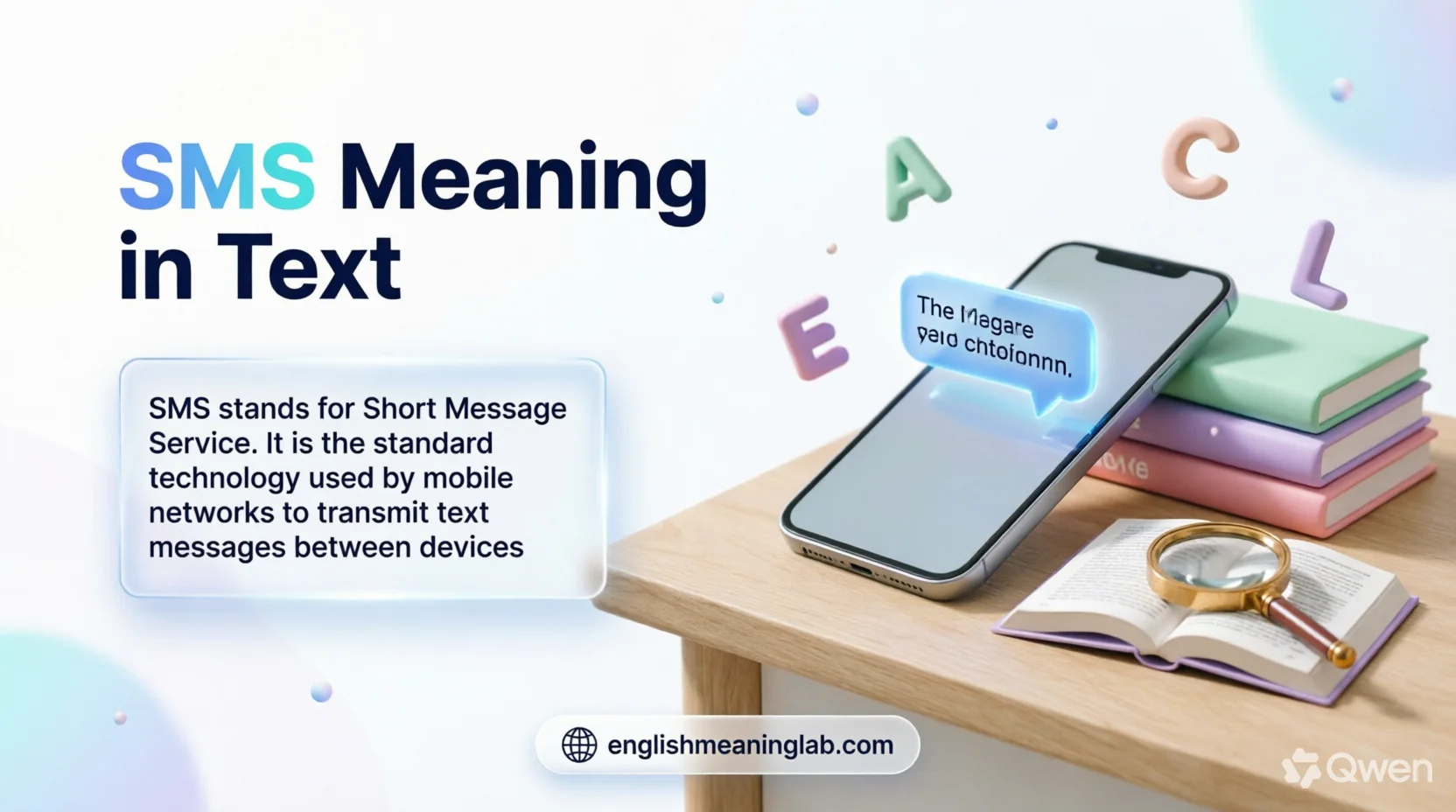
SMS stands for Short Message Service. It is the standard technology used by mobile networks to transmit text messages between devices.
When someone refers to an SMS, they are usually talking about a traditional text message sent through a cellular network rather than through an internet-based messaging application. SMS messages are generally limited in length and are designed primarily for text-only communication.
Examples include:
- A friend sending a regular text message.
- A bank sending a security code.
- A company sending appointment reminders.
- A service sending account notifications.
In everyday language, people often use the words “text message” and “SMS” interchangeably. While they are closely related, SMS specifically refers to the underlying messaging service used by mobile carriers.
The term is not usually considered slang. Instead, it is a technical abbreviation that has become part of common everyday language.
Background
The abbreviation SMS originated from the telecommunications industry. It was developed as a method for sending short text-based communications through mobile phone networks.
As mobile phones became more popular, SMS quickly evolved into one of the most widely used communication tools worldwide. Before smartphones and internet messaging applications became common, SMS was often the primary way people exchanged written messages electronically.
The popularity of SMS grew because it was simple, reliable, and available on virtually every mobile phone. Unlike many modern messaging platforms, SMS does not require both users to have the same application installed.
Today, internet messaging services have expanded communication options significantly. However, SMS remains important because it works across different devices and networks and is frequently used for authentication, alerts, and business communication.
Its continued use demonstrates how a relatively simple technology can remain valuable even as digital communication evolves.
Usage in Different Contexts
Chat
In chat conversations, SMS generally refers to a standard text message sent through a mobile carrier.
Example:
- “Send me an SMS when you arrive.”
Here, the speaker is simply asking for a text message.
Social Media
On social media platforms, SMS may appear when discussing messaging preferences, security verification, or communication methods.
Example:
- “I received the login code via SMS.”
In this case, the message contains a verification code sent to a mobile phone.
Professional Fields
Businesses frequently use SMS for communication with customers and employees.
Common uses include:
- Appointment reminders
- Delivery notifications
- Security alerts
- Customer support updates
- Marketing campaigns
Because SMS messages are typically read quickly, organizations often use them for important notifications.
Casual Conversations
In everyday conversation, people commonly use SMS as another way of saying “text.”
Example:
- “I’ll send the details by SMS later.”
The meaning remains straightforward and practical.
Meaning in Chat, WhatsApp, Instagram, and TikTok
In Chat
In chat environments, SMS typically means a regular text message sent through a mobile network.
Example:
- “I sent you an SMS yesterday.”
On WhatsApp
WhatsApp itself uses internet-based messaging rather than SMS. However, users may mention SMS when discussing verification codes or standard phone texting.
Example:
- “I didn’t get the SMS verification code.”
On Instagram
Instagram users may encounter SMS when setting up account security, receiving login codes, or discussing communication methods.
Example:
- “Instagram sent an SMS to confirm my account.”
On TikTok
TikTok users may also receive SMS verification messages during account setup or security checks.
Example:
- “Check your SMS messages for the code.”
Across these platforms, SMS almost always retains its standard meaning of a text message delivered through a cellular network.
Meaning in Physics, Medical, and Aircraft Terminology
Physics
SMS does not have a single universally recognized physics definition. If the abbreviation appears in a physics-related document, its meaning depends on the specific context and organization using it.
Medical Terminology
In medicine, SMS can occasionally represent specialized terms used within particular healthcare systems or organizations. However, there is no single medical meaning that is universally recognized across all healthcare settings.
Aircraft and Aviation Terminology
In aviation, SMS commonly stands for Safety Management System, a structured approach used to manage safety risks and improve operational safety.
Because abbreviations often have multiple meanings across industries, context is essential when interpreting SMS outside ordinary texting and communication.
Common Misconceptions
Several misunderstandings surround SMS.
SMS Means Social Media Service
This is incorrect. SMS stands for Short Message Service, not Social Media Service.
SMS and Internet Messaging Are the Same
Not exactly. SMS uses mobile carrier networks, while applications such as WhatsApp and similar services generally rely on internet connectivity.
SMS Is Outdated and No Longer Used
Although newer messaging platforms are popular, SMS remains widely used for alerts, security codes, and direct communication.
Every SMS Meaning Is Related to Texting
Not always. In specialized industries such as aviation, SMS can have entirely different meanings.
Similar Terms & Alternatives
Several terms are closely related to SMS.
MMS
MMS stands for Multimedia Messaging Service and allows the sending of images, audio, and other media.
Text Message
A general term commonly used to describe SMS messages.
DM
DM means Direct Message and usually refers to private messaging on social media platforms.
IM
IM stands for Instant Message and is generally associated with internet-based messaging services.
Chat Message
A broader term that can refer to messages sent through apps, websites, or communication platforms.
Although these terms are related, they do not all refer to the same technology.
How to Respond to It
If someone mentions SMS in a conversation, your response depends on the context.
Examples:
- “Sure, send me an SMS.”
- “I received the SMS. Thanks.”
- “Can you resend the SMS?”
- “I haven’t received the SMS yet.”
- “I’ll text you through SMS shortly.”
When SMS refers to a verification code or notification, a simple acknowledgment is usually sufficient.
If someone asks you to communicate via SMS, you can respond by sending a standard text message through your mobile device.
Differences from Similar Words
| Term | Meaning | Primary Usage |
|---|---|---|
| SMS | Short Message Service | Standard mobile text messaging |
| MMS | Multimedia Messaging Service | Messages containing media files |
| DM | Direct Message | Private social media messaging |
| IM | Instant Message | Internet-based messaging |
| Electronic mail | Formal and long-form communication |
The biggest difference is that SMS relies on mobile carrier networks, while many other messaging methods depend primarily on internet connectivity.
Relevance in Online Conversations & Dating Apps
SMS remains relevant in modern online communication.
Many dating apps use SMS verification during account creation and security checks. Users may also move conversations from a dating platform to SMS when they want a more direct communication method.
In online conversations, SMS is often mentioned when:
- Exchanging contact information
- Receiving authentication codes
- Confirming appointments
- Communicating outside social media apps
The interpretation is usually straightforward. However, the relationship between participants can influence why someone prefers SMS over another messaging platform.
For example, a person may choose SMS because it is simple, widely available, and does not require a specific application.
FAQs
What does SMS meaning in text refer to?
SMS meaning in text refers to Short Message Service, the standard technology used for sending text messages through mobile phone networks.
What does SMS mean in chat?
In chat, SMS usually means a regular text message sent from one phone number to another through a cellular carrier.
Is SMS a slang term?
No, SMS is not slang. It is a technical abbreviation for Short Message Service that has become a common part of everyday communication.
What does SMS mean on social media?
On social media, SMS generally refers to text messages, login verification codes, notifications, or communication through a mobile network.
How do you respond to an SMS message?
You can respond by sending a standard text reply. The response depends on the content of the message and the conversation context.
Can SMS have different meanings?
Yes. While SMS most commonly means Short Message Service, some industries may use the abbreviation for different technical or organizational terms.
Is SMS the same as WhatsApp messages?
No. SMS uses mobile carrier networks, while WhatsApp typically uses an internet connection to send and receive messages.
Why do companies still use SMS?
Companies continue using SMS because it is widely accessible, reliable, and effective for delivering alerts, verification codes, reminders, and important notifications.
Conclusion
SMS is one of the most recognizable abbreviations in digital communication and most commonly stands for Short Message Service. It refers to the standard technology that allows text messages to be sent through mobile phone networks.
Although newer messaging applications have become extremely popular, SMS remains an essential communication tool for personal conversations, business notifications, security verification, and customer updates.
The meaning of SMS is usually straightforward in texting and social media contexts, but the abbreviation can have different interpretations in specialized fields such as aviation. Understanding the surrounding context is therefore important whenever you encounter the term.
Whether you see SMS in a phone setting, receive an authentication code, or hear someone mention sending a text, the abbreviation generally points to traditional mobile text messaging.
Knowing this meaning makes it easier to understand modern communication and use messaging technologies confidently.