If you have recently come across the abbreviation EM in a text message, social media comment, or online chat, you may be wondering what it means.
Like many internet abbreviations, EM can have different meanings depending on the context in which it is used.
This is one of the main reasons people search for the term online. Understanding the meaning behind text abbreviations helps avoid confusion and makes digital communication easier.
In casual conversations, EM is often used as a shortened form of a word or phrase to save time while typing. However, its interpretation can vary between messaging platforms, professional discussions, and specialized fields.
The same abbreviation may carry one meaning in a personal chat and a completely different meaning in a technical or academic setting.
This guide explains the most common meanings of EM, how it is used across different platforms, and what you should know when you encounter it in a conversation.
Quick Answer
EM meaning in text usually refers to “them.” People often shorten the word “them” to “em” in casual texting, online chats, and social media conversations. For example, someone might write “Tell em I said hi” instead of “Tell them I said hi.” The exact meaning can vary depending on the context, but this is the most common usage in everyday messaging.
Meaning & Definition
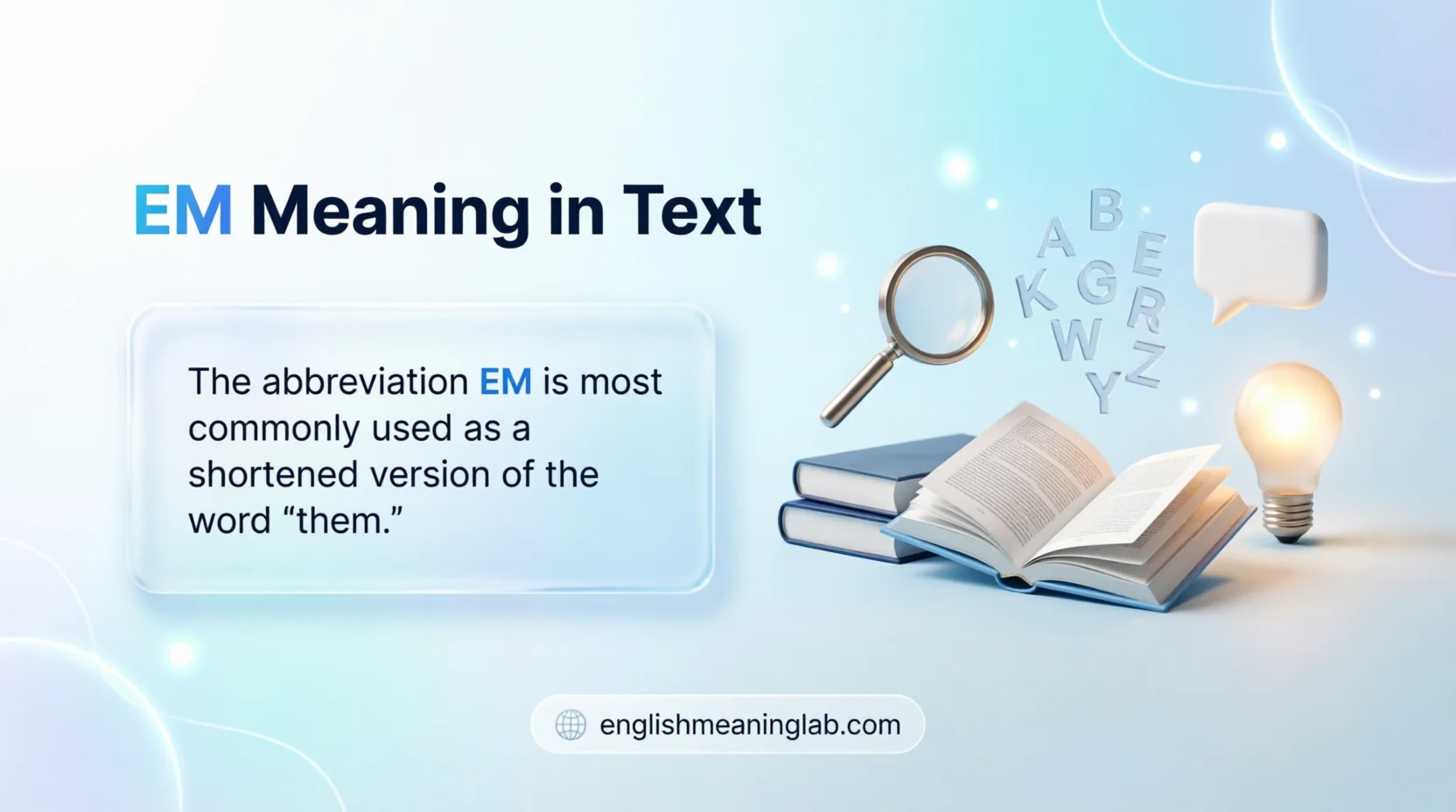
The abbreviation EM is most commonly used as a shortened version of the word “them.” This usage comes from informal spoken English, where people sometimes pronounce “them” as “’em.” Over time, this pronunciation became popular in texting and online communication.
For example:
- “Give em a chance.”
- “Tell em we’re coming.”
- “Ask em what happened.”
In these examples, EM simply replaces the word “them” without changing the meaning of the sentence.
However, EM is not limited to this definition. Depending on the context, it may also stand for:
- Emergency Management
- Email Marketing
- Electromagnetic
- Electron Microscopy
- Engineering Management
- Expectation Maximization
Because of these multiple interpretations, understanding the surrounding conversation is important.
In everyday texting, though, the abbreviation is generally understood as a casual replacement for “them.”
The popularity of shortened words like EM reflects how modern communication prioritizes speed and convenience. People often remove letters, abbreviate phrases, and use slang to make conversations faster and more informal.
Background
The use of EM as a substitute for “them” has roots in spoken English. For centuries, people have informally pronounced “them” as “’em.” This pronunciation eventually found its way into written communication.
When texting became popular, users started writing words the same way they spoke them. As a result, “’em” became commonly written as “em” in messages and online chats.
The growth of smartphones, social media platforms, and instant messaging apps further increased the use of abbreviations. People wanted faster ways to communicate without typing long sentences. Short forms such as LOL, BRB, IMO, and EM became part of internet culture.
Today, EM appears in various forms of communication. Younger users may use it naturally in casual conversations, while others encounter it through social media comments, gaming communities, and messaging applications.
Outside texting culture, EM also became an important abbreviation in professional and academic fields. Scientists, engineers, marketers, and business professionals often use EM as shorthand for technical concepts. Because of this, the meaning changes significantly depending on who is using it and where it appears.
The evolution of EM demonstrates how language adapts to technology. What started as a spoken shortcut became a widely recognized digital abbreviation used by millions of people worldwide.
Usage in Different Contexts (Chat, Social Media, Professional Fields)
The meaning of EM can vary based on the environment where it appears.
Casual Chat
In personal conversations, EM usually means “them.”
Example:
- “Invite em to the party.”
- “I haven’t seen em lately.”
Social Media
On platforms such as Facebook, X, Instagram, and TikTok, users often use EM in comments and captions.
Example:
- “Love em!”
- “Show em what you got.”
Gaming Communities
Gamers frequently use EM as a quick way to refer to other players.
Example:
- “Beat em easily.”
- “Help em complete the mission.”
Business and Marketing
In professional settings, EM can stand for Email Marketing.
Example:
- “Our EM campaign increased sales.”
Scientific Fields
Researchers may use EM to refer to Electromagnetic concepts or Electron Microscopy.
Management and Administration
Organizations may use EM to mean Emergency Management or Engineering Management.
The context surrounding the abbreviation usually reveals its intended meaning.
Meaning in Chat, WhatsApp, Instagram, TikTok
Chat Messages
In texting, EM almost always means “them.”
Example:
- “Call em later.”
- “Tell em the good news.”
WhatsApp conversations are often informal, making EM a common abbreviation.
Example:
- “Send em the photos.”
- “Ask em if they’re available.”
Users may write EM in captions or comments.
Example:
- “Love em all.”
- “Support em!”
TikTok
TikTok creators and viewers frequently use abbreviated language.
Example:
- “Show em your talent.”
- “Teach em how it’s done.”
Across these platforms, EM generally functions as a quick and casual substitute for “them.”
Meaning in Physics, Medical, and Aircraft Terminology
Physics
In physics, EM commonly stands for Electromagnetic.
Examples include:
- Electromagnetic waves
- Electromagnetic fields
- Electromagnetic radiation
Medical Field
In healthcare, EM may refer to:
- Emergency Medicine
- Electron Microscopy
- Electromyography (in some contexts)
Medical professionals typically understand the intended meaning based on the discussion.
Aircraft and Aviation
In aviation-related discussions, EM can refer to terms involving emergency procedures, engineering management, or equipment manuals depending on the organization and context.
Unlike casual texting, technical fields rely heavily on context and industry-specific terminology when using EM.
Common Misconceptions
Several misunderstandings surround EM.
It Always Means One Thing
Many people assume EM has a single definition. In reality, it can represent multiple phrases depending on context.
It Is a New Internet Slang Term
Although popular online, its roots come from older spoken English pronunciation.
It Is Always Professional Terminology
Many users encounter EM in scientific or business contexts and forget that it is also widely used in everyday conversations.
It Is a Typing Mistake
Some people think EM is simply a misspelling of another word. Often, it is an intentional abbreviation.
Understanding the context helps avoid these misconceptions.
Similar Terms & Alternatives
Several alternatives serve a similar purpose in casual communication.
Them
The full version of the word.
Example:
- “Tell them.”
‘Em
The traditional shortened form.
Example:
- “Tell ’em.”
They
Sometimes used when referring to people generally.
Those People
A more formal alternative.
Depending on tone and audience, users may choose different forms while expressing the same idea.
How to Respond to It
Responding to EM depends on how it is used.
If It Means “Them”
Simply continue the conversation naturally.
Example:
- “Tell em I’m on my way.”
- Response: “Sure, I’ll let them know.”
If You Are Unsure
Ask for clarification.
Example:
- “What do you mean by EM?”
In Professional Contexts
Determine whether EM refers to a technical term before responding.
Context is the best guide when interpreting the abbreviation.
Differences from Similar Words
EM vs Them
EM is informal, while “them” is the standard spelling.
EM vs They
“They” refers to the subject of a sentence, whereas EM (them) usually acts as an object.
Example:
- They arrived early.
- I called em yesterday.
EM vs Email Marketing
In business discussions, EM often means Email Marketing rather than “them.”
The difference becomes clear from the surrounding conversation.
EM vs Electromagnetic
In scientific discussions, EM commonly refers to electromagnetic concepts rather than texting slang.
Recognizing the topic helps determine the correct interpretation.
Relevance in Online Conversations & Dating Apps
Online communication often encourages short, fast messages. As a result, abbreviations such as EM remain popular.
On dating apps, users may write:
- “Tell em about your hobbies.”
- “Ignore em if they’re rude.”
In these situations, EM usually means “them.”
The abbreviation helps keep conversations brief and conversational. Because dating apps emphasize quick communication, many users prefer informal language over complete sentences.
However, context still matters. If someone uses EM in a profile related to work, science, or business, the abbreviation may have a different meaning.
Understanding common texting abbreviations can make online interactions smoother and reduce misunderstandings.
FAQs
What does EM mean in text?
EM most commonly means “them” in text messages. It is an informal abbreviation used to make typing faster.
Is EM a slang term?
Yes, when used as a substitute for “them,” EM is considered informal internet slang and texting shorthand.
What does EM mean on social media?
On social media platforms, EM usually means “them,” although it can have other meanings depending on the topic being discussed.
What does EM mean in WhatsApp messages?
In WhatsApp chats, EM is commonly used as a shortened form of “them.”
Can EM have different meanings?
Yes. Besides “them,” EM can stand for terms such as Electromagnetic, Emergency Management, Email Marketing, and Electron Microscopy.
Is EM professional language?
It can be. In business, science, and technical fields, EM is often used as a professional abbreviation.
How do I know which meaning is correct?
Look at the context of the conversation. The surrounding words usually reveal the intended meaning.
Should I use EM in formal writing?
Formal writing generally uses the complete word “them” instead of the abbreviation EM.
Conclusion
EM is a versatile abbreviation with several possible meanings, but in everyday texting and online conversations, it most commonly means “them.”
People use it as a quick and informal shortcut that makes messaging faster and more convenient. Whether you see it in a text message, WhatsApp chat, Instagram comment, or TikTok caption, it often serves as a simple replacement for the word “them.”
At the same time, EM can represent technical terms in business, science, medicine, and other professional fields.
This is why context is essential when interpreting the abbreviation. Looking at the topic, audience, and surrounding words will usually reveal the intended meaning.
As digital communication continues to evolve, abbreviations like EM remain a common part of online language. Understanding them can help you communicate more effectively and avoid confusion in both casual and professional conversations.